To members of the press
Yuzuka Sasaki photographs the light of radiation with an ordinary camera
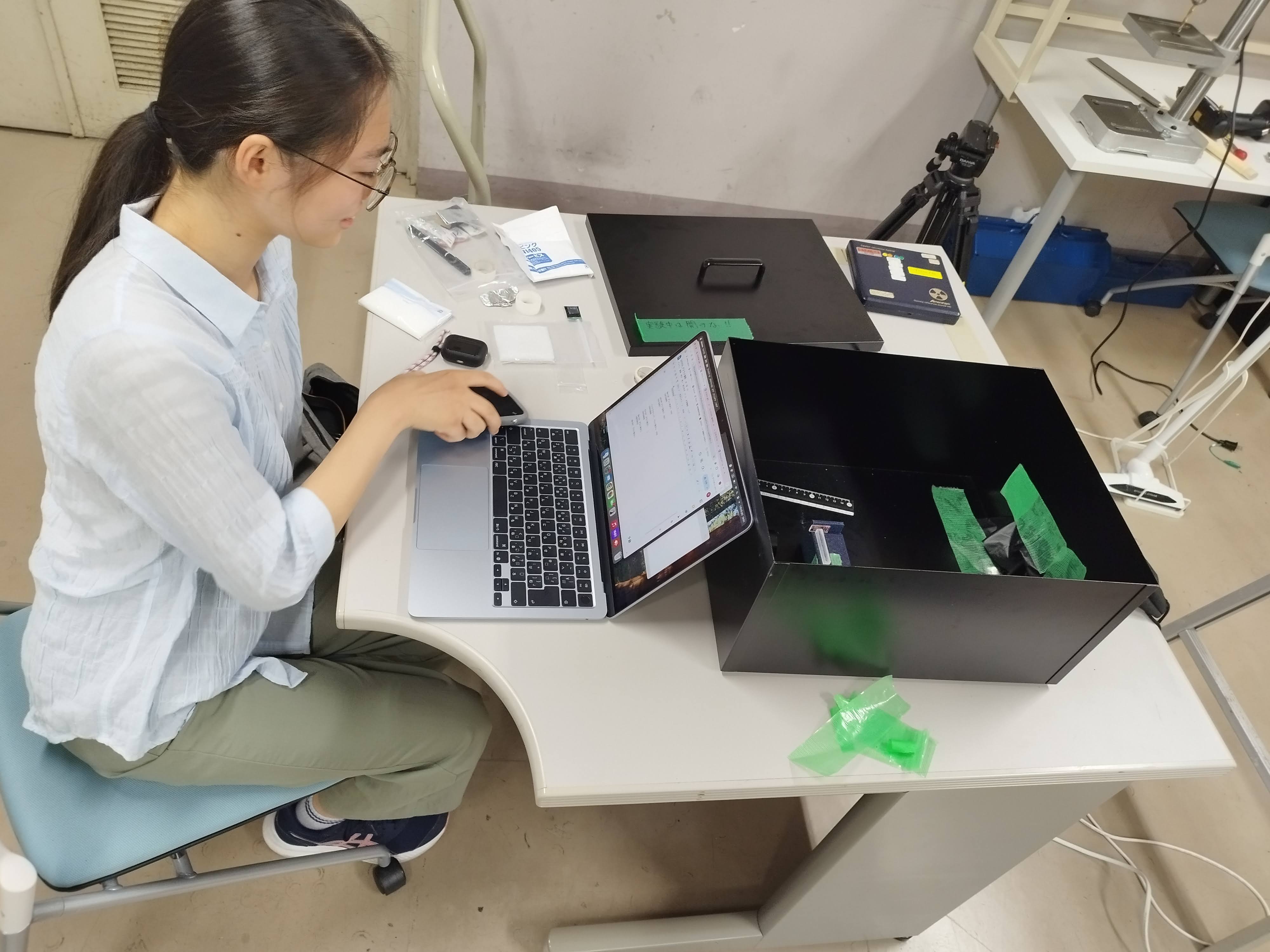
Yuzuka Sasaki, who has been measuring cosmic rays with Accel Kitchen since her first year of junior high school, has succeeded in directly photographing with an ordinary digital camera the faint light that radiation produces inside a crystal. She further showed that the way that light spreads reveals differences in the energy of the radiation. All it takes is a cardboard light-tight box and a consumer camera: no specialised high-sensitivity photodetector is needed. She has turned the whole procedure into an experiment that fits within a single class period, now published in Physics Education (IOP Publishing). The work was carried out with the support of the SEEDS program of The University of Osaka and Accel Kitchen.
- Paper title
- “Using Consumer Cameras to Observe Scintillation Light from Radiation”
- Authors
- Yuzuka Sasaki, Yuuki Wada, Kazuo S. Tanaka
- Journal
- Physics Education (IOP Publishing)
- Published
- 1 September 2026
- Volume
- Vol. 61, No. 5, 055007
- DOI
- 10.1088/1361-6552/ae95cf
Measuring cosmic rays since junior high school
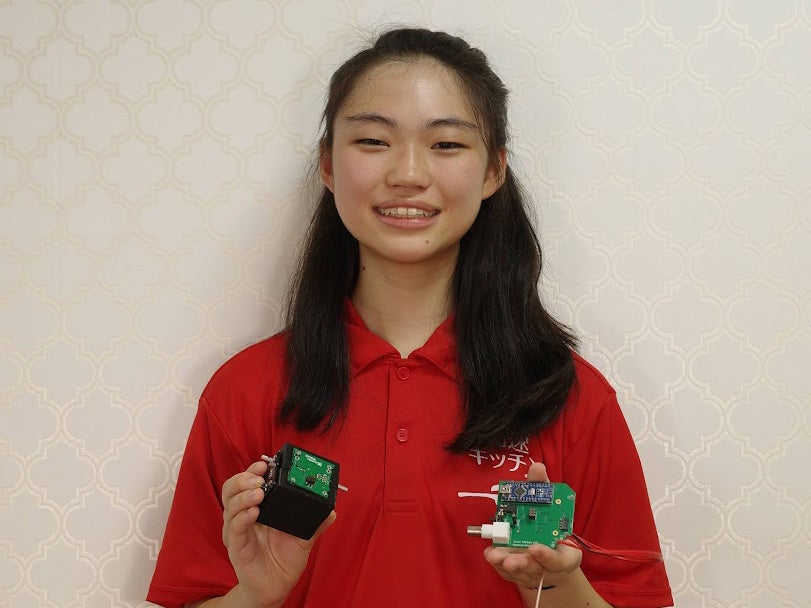
Sasaki joined Accel Kitchen in her first year of junior high school. With a borrowed detector running at home, she measured cosmic rays and compared her data against the GOES satellites operated by NOAA and the geomagnetic observatories of the Japan Meteorological Agency, asking whether space weather is reflected in the cosmic rays arriving at ground level. She presented the results at the Hyper Interdisciplinary Conference in Osaka in 2022.
The question behind the present paper arose in her second year of junior high school. Supported by the SEEDS program of The University of Osaka and guided by Dr Yuuki Wada — a co-author of this paper — she set out to find whether the light a crystal emits under radiation could be captured with an ordinary camera. She presented that early work at the High School Radiation Class in 2023 and won an Award for Excellence. This paper is that same question, carried through over several years.
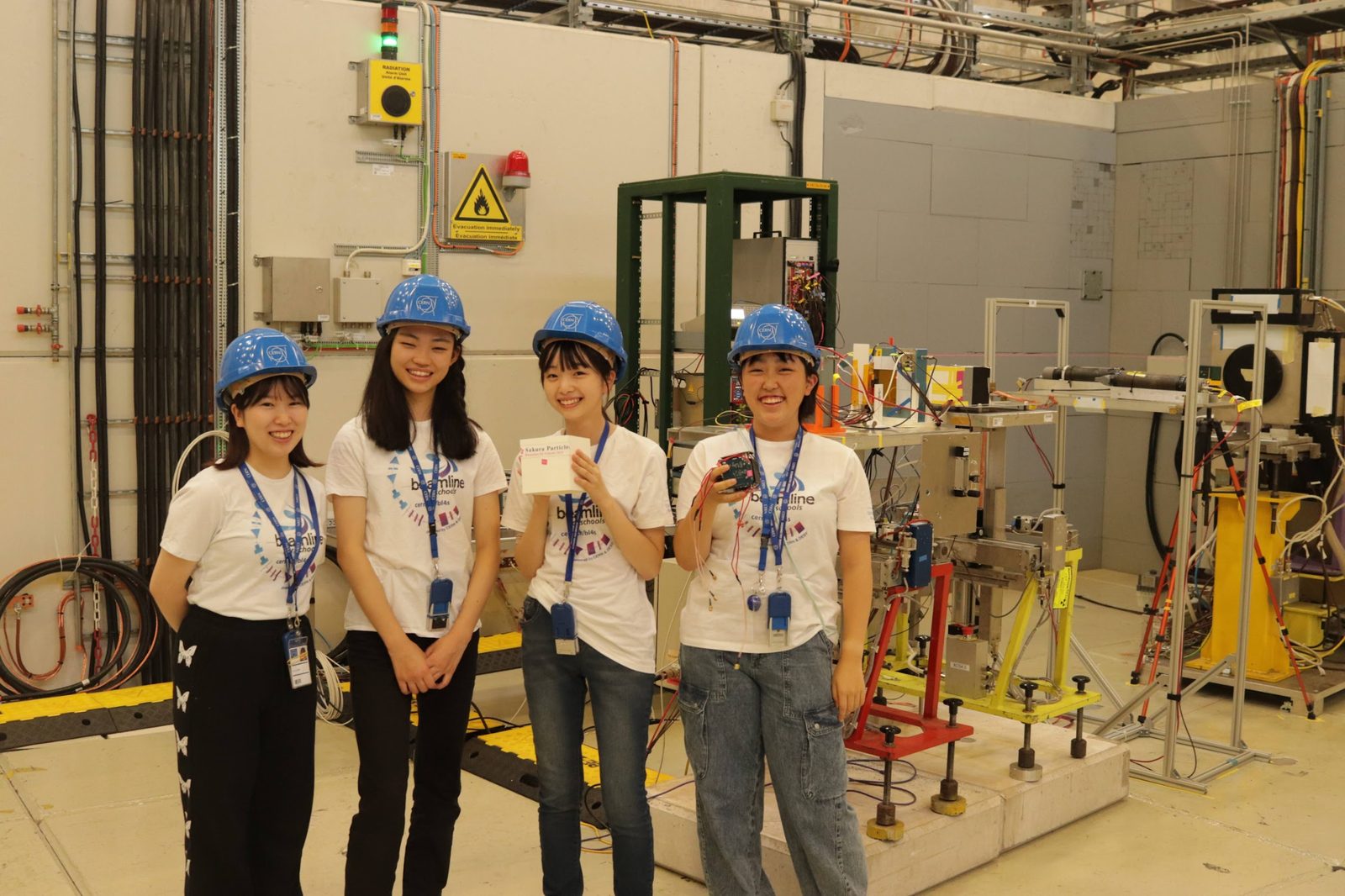
In her first year of senior high school she joined "Sakura Particles", a high-school team formed within Accel Kitchen, to enter Beamline for Schools, the international experiment competition run by CERN. Out of a record 461 proposals from around the world, the team became the first from Japan ever to win the grand prize, and spent two weeks running their experiment on a beamline at CERN in Geneva.
Then, in her second year of senior high school in 2025, she was chosen as one of four members of Japan's national team for the International Nuclear Science Olympiad (INSO) — a competition in nuclear science and radiation technology for entrants under 20 — and took part in the second edition, held in Malaysia. It was the first time Japan had ever sent a team.
An inquiry that began with a detector at home thus led to one international stage after another. The question at its origin — the wish to see invisible radiation with her own eyes — is what this paper answers.
The light is right there inside the detector — and students never see it
For a long time the cloud chamber was the only educational tool that let students directly see radiation. In recent years small detectors pairing a scintillator — a material that glows when radiation strikes it — with an SiPM to turn that glow into an electrical signal have spread into schools, and Accel Kitchen has lent more than 300 of them to junior- and senior-high students. Yet what reaches the student is only a number on a display and an audible click: the scintillation light itself, the heart of the detector, stays hidden. The experience of measuring radiation breaks off at exactly the most interesting point.
Because that light is so faint, the received wisdom has been that a specialised, expensive photodetector is unavoidable. Meanwhile, however, the sensitivity of the sensors in everyday digital cameras has improved dramatically. This study starts from a simple question: could a camera of the kind schools already own capture that light directly?
A cardboard light-tight box and two ordinary cameras
The apparatus is a cardboard box lined with black light-blocking cloth. Inside it, a slender caesium iodide (CsI) crystal about 5 cm long lies on its side, with a radioactive source at its left-hand edge and a camera facing it side-on. Then the box is closed and the shutter is held open for ten minutes. Every indicator lamp is taped over so that no external light gets in at all.
Two deliberately different cameras were compared. One was an ordinary consumer compact digital camera; the other a cooled camera of the kind popular with school astronomy clubs and amateur astronomers. The latter cools its sensor to suppress noise, but it is a mass-produced product rather than a specialised scientific instrument — non-cooled models start from a few hundred dollars, cooled ones run to the order of $700–1000. The radiation came from three sealed sources (americium, barium and caesium), encapsulated in resin so that no material can escape.
The result: both cameras recorded the scintillation light. The edge where the source sat was brightest, fading with distance. And the width of the bright region differed clearly between sources — widest for the high-energy caesium, then barium, then americium. This puts directly before the eye the physics that higher-energy radiation penetrates deeper into the crystal.
The cooled camera gives less noise and a sharper distinction, but the same ordering is readable with the consumer digital camera alone. The team also captured the afterglow — the crystal continuing to emit for a while after the radiation is removed.
These results are a qualitative, educational comparison of how deep radiation penetrates, not a precise measurement. Even so, they show with real data that a single photograph from a consumer camera can distinguish the type and energy of radiation from the way the light spreads across it.
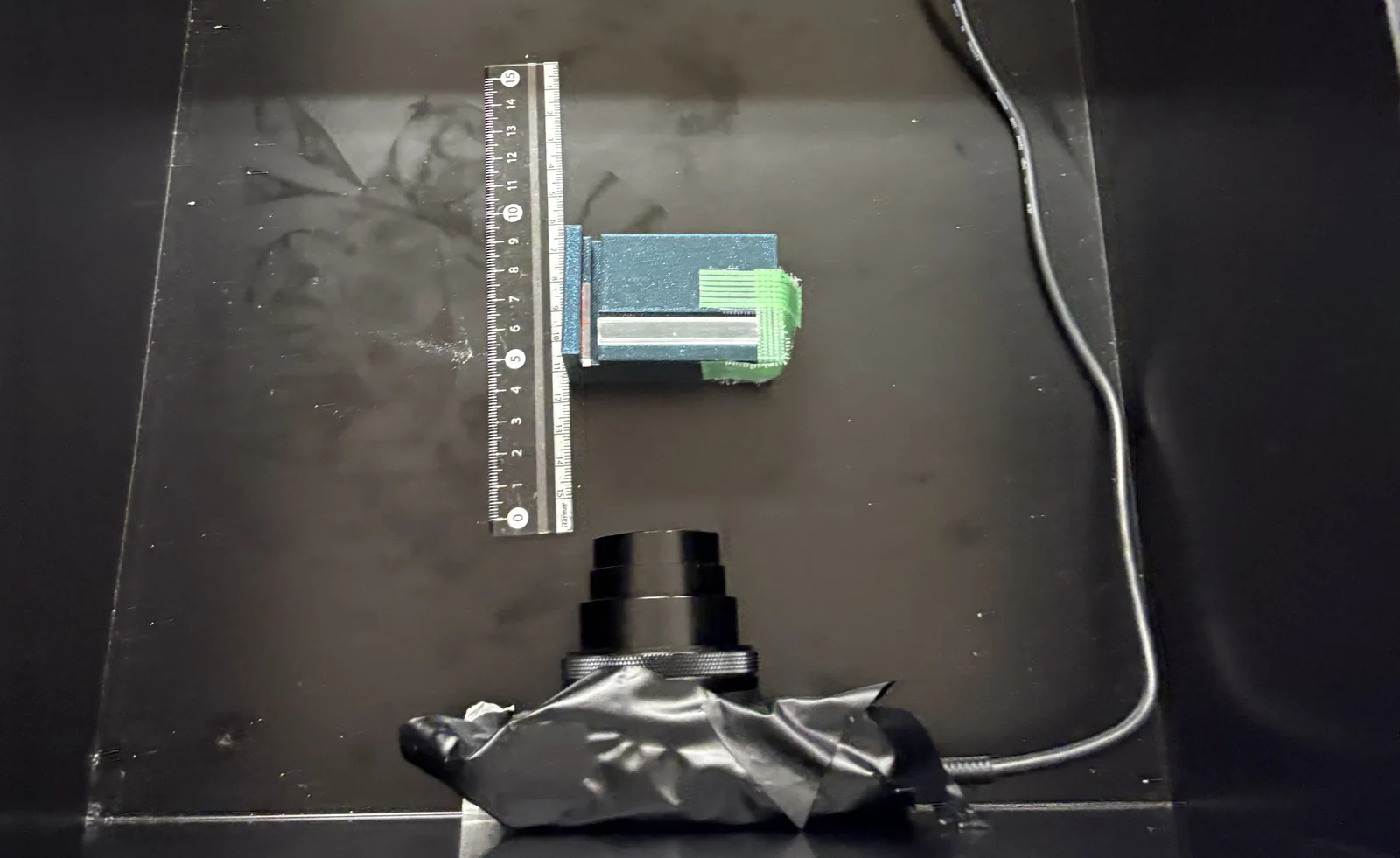
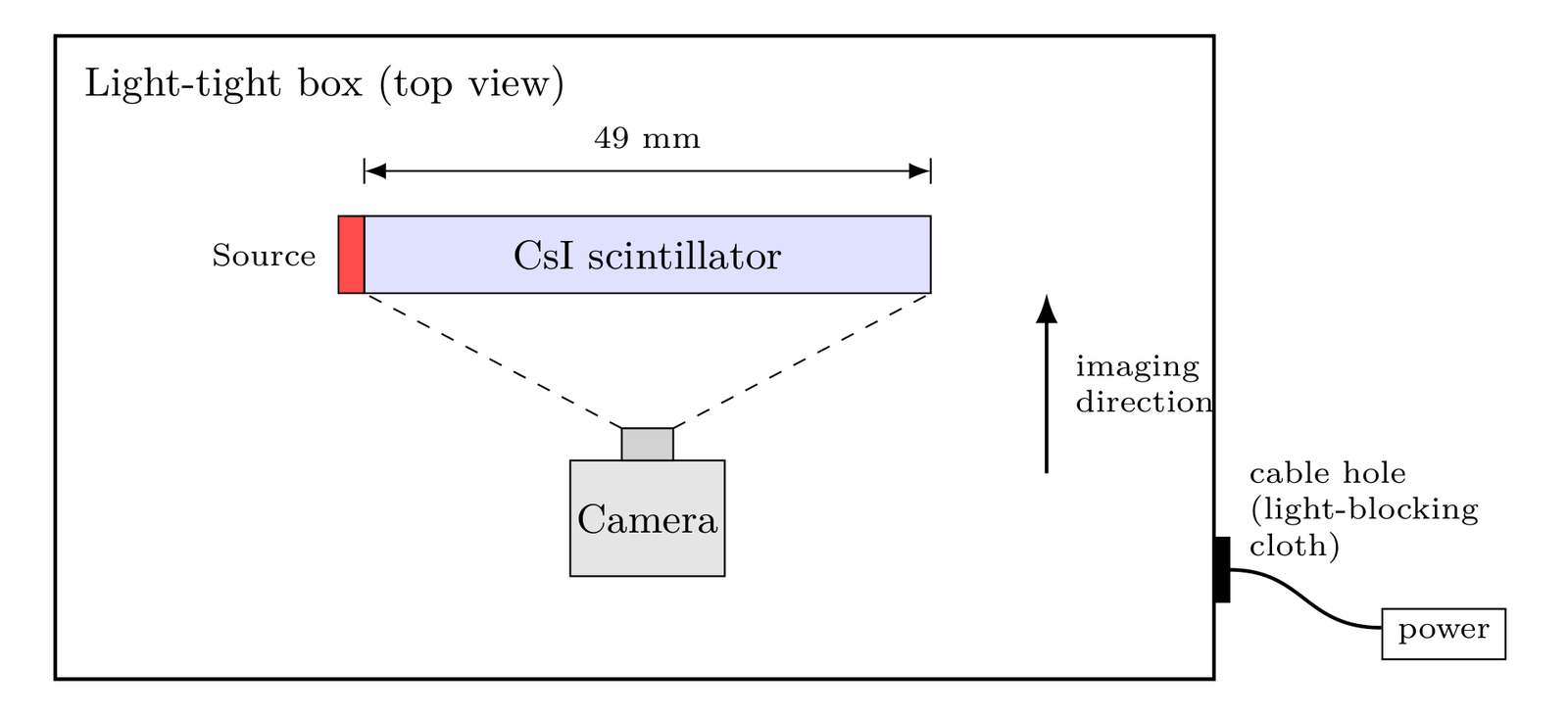
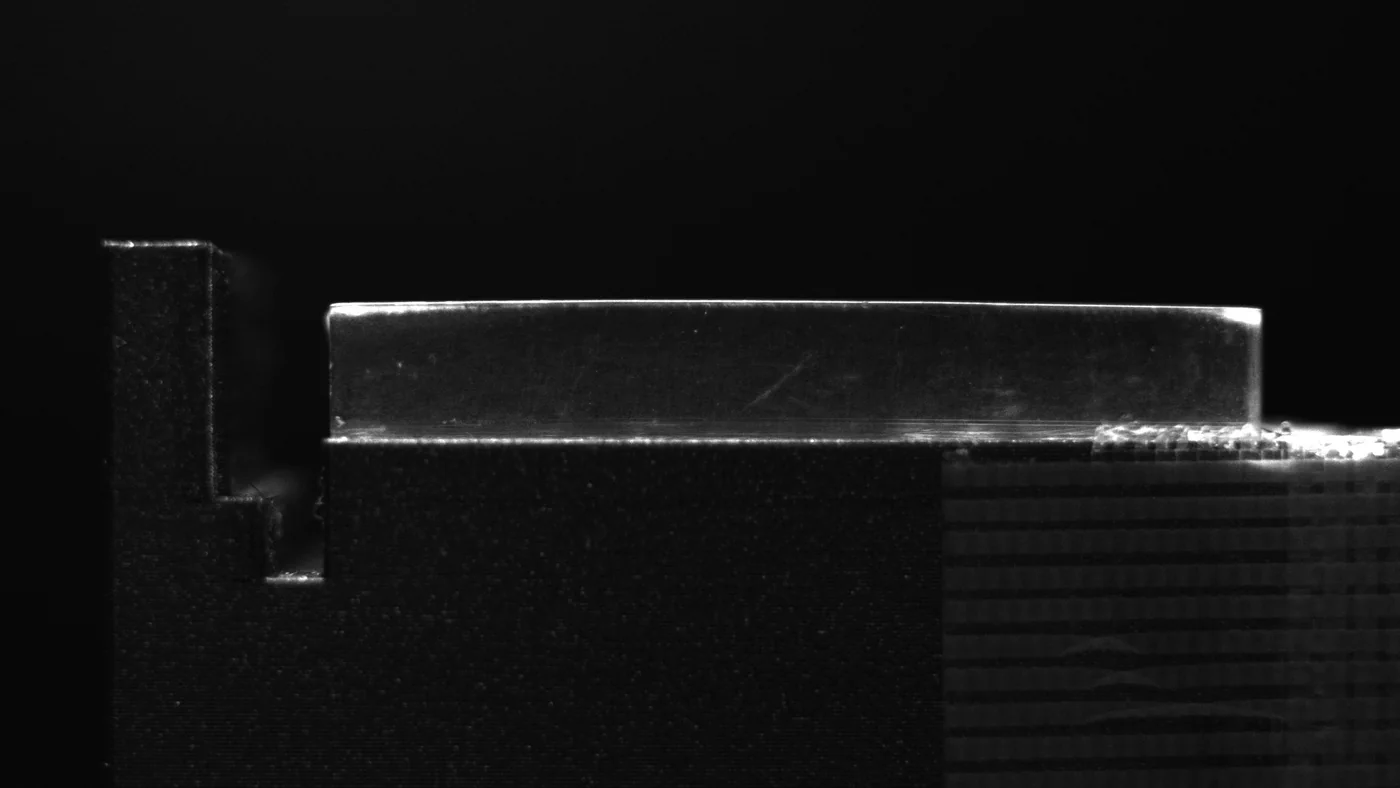
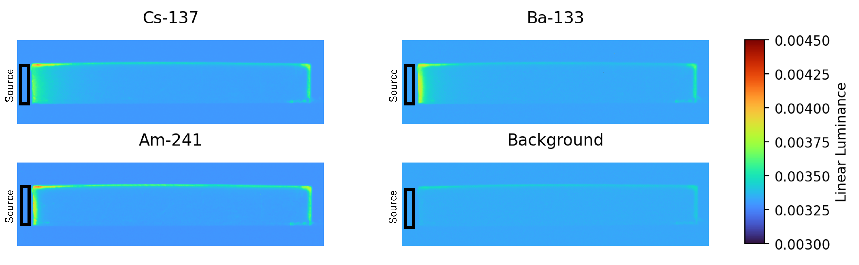

- Scintillator
- Caesium iodide (CsI) crystal, 49×10×6 mm³
- Cameras
- Consumer compact camera SONY DSC-RX100M7 (F2.8, ISO 12800) / cooled CMOS camera ZWO ASI533MM Pro with a 25 mm F1.8 lens
- Exposure
- 600 s for both, recorded as 16-bit TIFF
- Sources
- Am-241 (59.5 keV gamma ray) / Ba-133 (356 keV and 81 keV) / Cs-137 (662 keV), all sealed sources encapsulated in acrylic resin
- Analysis
- sRGB pixel values converted to linear luminance following the international standard IEC 61966-2-1, then one-dimensional intensity profiles against distance fitted with f(x) = a·e−bx + c. The decay constant b is 0.293 for Cs-137, 0.745 for Ba-133 and 1.606 mm⁻¹ for Am-241 — smaller as the energy rises
- Afterglow
- Seven 300-s exposures at 300-s intervals with the box kept light-tight, showing the average luminance decaying towards the background level
An experiment that fits one class period
The point of the method is that an ordinary school can reproduce it as it stands. All it takes is a light-tight enclosure (a cardboard box lined with black cloth is enough), a camera capable of long exposures, a small tripod or stand, and one or more sealed check sources. No specialised high-sensitivity photodetector is needed. A consumer digital camera the school already owns will do; a cooled camera is available if a cleaner result is wanted, but since the difference between sources is visible with the consumer camera alone, it is an optional upgrade rather than a requirement.
On timing: building the box and setting up the camera takes roughly 15–20 minutes, each source needs a single exposure of about 10 minutes, and reading the images takes a further 20–30 minutes. The core activity therefore fits within a single class period, with the analysis optionally continued as homework. The student procedure has four steps: (1) assemble the light-tight box and confirm with a test exposure that no external light leaks in; (2) place the crystal on the stand with a sealed source at one edge; (3) expose for ten minutes without opening the box; (4) plot the brightness that appears against distance along the crystal.
Students see for themselves that the region near the source is bright, and that how wide that bright region is depends on the source. That leads naturally to questions: why does higher energy reach deeper? How does a crystal turn invisible radiation into light? Along with hands-on experience of long-exposure imaging and simple image analysis, the activity delivers something students rarely get — actually seeing the scintillation light at the heart of the detector.
On safety. Every source used here falls below the legal threshold of Japan's Act on the Regulation of Radioisotopes and is therefore not subject to regulation. The sources were kept in a locked, clearly labelled container and handled only under the supervision of a trained instructor. Note, however, that the availability and regulation of sealed sources differ from country to country. Teachers should use only sources permitted locally and follow their national regulations and institutional guidance.
The authors
*Affiliations as of submission of the paper. Yuzuka Sasaki is the first author.
This work was supported by the SEEDS program of The University of Osaka and The Mitsubishi Memorial Foundation for Educational Excellence.
Glossary
A scintillator is a material that emits a faint flash of light when radiation strikes it; that emission is the scintillation light. It converts invisible radiation into visible light and sits at the heart of radiation detectors used everywhere from basic research to medicine and industry. The caesium iodide (CsI) used here is one of the classic scintillator crystals.
A semiconductor sensor that converts very weak light into an electrical signal and amplifies it. Because scintillation light is so faint, an SiPM or a conventional photomultiplier tube is normally required. They are highly sensitive but expensive, which has kept such experiments out of reach for most schools.
A radioactive source encapsulated in resin or metal so that the material cannot escape. Those used in this study all fall below the legal regulatory threshold and are therefore exempt, but availability and handling rules differ from country to country.
A science and technology talent-development program run by The University of Osaka for high-school students, giving them access to a university research environment and the chance to set and pursue their own research questions. Sasaki has been supported by the program since her second year of junior high school, and carried out this study within it. seeds.osaka-u.ac.jp
An experiment-proposal competition that CERN, the European Organization for Nuclear Research in Switzerland, runs for high-school students worldwide. The winning teams travel to CERN and run their own experiment on a real beamline. In her first year of senior high school, Sasaki was part of "Sakura Particles", an Accel Kitchen team that became the first from Japan to win the grand prize, chosen from a record 461 proposals. That work has since been published in the journal NIM-A. beamlineforschools.cern
An international competition in nuclear science and radiation technology for entrants under the age of 20. The first edition was held in the Philippines in 2024; the second, in 2025, took place in Malaysia with the support of the International Atomic Energy Agency (IAEA). Sasaki was one of the four students in the first national team Japan has ever sent. Information on Japan's participation is collected on the Japan Atomic Energy Relations Organization's page (in Japanese).
Accel Kitchen works towards a world where anyone can explore astrophysics and particle physics under their own steam, driven mainly by undergraduate and graduate students from science, engineering and many other fields. The activity has grown into what is now the largest particle-physics inquiry network in the world. We distribute affordable, easy-to-use particle detectors to junior- and senior-high students who want to measure particles and probe the properties of the very small, connect them with researchers and citizen-science projects, and create openings for joint research with students and scientists around the world. accel-kitchen.com/en
About Accel Kitchen
Accel Kitchen is an organization that lends particle detectors to junior- and senior-high students free of charge and supports their inquiry into the universe and particle physics in partnership with research institutes. To date we have lent out more than 300 detectors and supported the inquiry of over 200 students. Participation is free.
Contact for this release
- Accel Kitchen LLC, Press contact: Maiko Sudo
Tel: +81-3-4500-0403 / E-mail: info@accel-kitchen.com - High-resolution experiment photos and figures, interview arrangements with the authors, and expert answers to technical questions about the paper are all available on request.