WEB APP · BROWSER ONLY Spectrum inquiry for teens

Your own voice,
let's take a look. A web app that visualizes, in real time in your browser, the spectrum of timbre — the one of the "three elements of sound" covered in junior-high science that is hardest to handle quantitatively.
Use it for classroom demonstrations or for students' own inquiry activities, on any device.

0views
waveform · spectrum ·
spectrogram, side by side
0runs
on-site classes &
workshops delivered
2019
launched and in
continuous use since
01 background

In junior-high science, timbre goes untold.

Under the current national curriculum, junior-high science covers the three elements of sound (loudness, pitch, and timbre) in its "properties of sound" unit, but timbre is hard to treat quantitatively and is rarely taken up in class.
A useful figure for visualizing that timbre is the spectrum. By Fourier-decomposing a waveform and displaying its frequency components, features of a sound that are hard to see from the waveform alone come into clear view.
This app is a browser-based spectrum-visualization tool, built so that students can record, examine, and think about sound themselves and grow more curious about sound and waves.

The sound-visualization app running on a laptop and a smartphone, showing waveform, spectrum, and the spectrum's change over time all at once
browser app · laptop & smartphone
three elements
Of the three elements
of sound, timbre resists numbers

Loudness can be measured by amplitude and pitch by frequency. Timbre, by contrast, is "the quality that makes sounds of the same pitch and loudness sound different," and that difference is hard to spot at a glance from the waveform.

spectrum view
Visualize frequency
components with a spectrum

Fourier-decompose the waveform and display the intensity of the frequency components it contains. Even for sounds of the same pitch, you can see for yourself that a different amount and distribution of harmonics means a different timbre.

giga school
A spectrum on every
device, right in the browser

Published as a web app so it works easily even on the one-device-per-student tablets rolled out under Japan's GIGA School program. No install, any OS — if there's a microphone, you can visualize the spectrum on the spot.

Conceptual diagram of the three display stages: waveform → spectrum → spectrogram
waveform → spectrum → spectrogram

Beyond classroom demonstrations, it also works as a tool for research themes and inquiry activities close to students' own lives.
Language, voice, music, science — spectral analysis of sound reaches across subjects, extending all the way to STEAM education and the SDGs.

Map of application areas for sound analysis: language (foreign-language vowel pronunciation practice), voice (animal calls, emotion), music (strings, bowing, playing techniques), science (internal diagnosis by tapping sounds, frequency response of sound-absorbing materials)
language · voice · music · science · application areas
02 use cases

Voices and instruments, decoded with the spectrum.

Vowel formant analysis, comparing the timbre of each violin string, and activities to create single-frequency tones or noise.
All can be done with everyday materials, and each has been tackled in school lessons and in students' own independent inquiry.

case · vowel formants

Analyzing vowels

Vowel timbre is known to be characterized by its formant frequencies. The characteristic peaks that appear on the spectrum as you vocalize are called, from the lowest up, F1, F2, F3, and so on.

  • F1: roughly corresponds to how open the mouth is. Open your mouth wider and the frequency rises.
  • F2: roughly corresponds to tongue position. The further forward the tongue, the higher the frequency.

Since vowels can be identified from the F1–F2 relationship, you can even run an activity where students guess which of "a, i, u, e, o" was pronounced from the spectrum image alone.

  • Guess what is being said from the spectrum image
  • Survey formant frequencies across the class and analyze their correlation with sex or height
  • Compare the pronunciation of the English vowels ʌ / æ / ɑ against your own
Example spectra of the vowels 'a, i, u, e, o'; the F1 and F2 values differ for each vowel
vowel · spectrum samples
Zoomed-in spectrum during vowel vocalization, with the peak positions of F1, F2, and F3 marked
F1 · F2 · F3 peaks
case · violin strings

Analyzing instruments (violin)

An example that pairs with hands-on instrument activities, such as in music class. A violin has four strings — G, D, A, and E — and because they differ in thickness and material, they differ not only in pitch but also in timbre. As you play up the scale from the low notes and switch strings, the spectrum reveals differences not just in pitch but in timbre.

What's more, even the same string sounds different from brand to brand. Plot the peak intensity of each harmonic and you can run an inquiry that matches subjective impressions to the spectrum: Dominant has the classic balance, Alphayue has strong 2nd and 3rd harmonics for a thick timbre, and Tonica is rich in high-frequency content and brilliant.

Spectrum comparison of notes played on the violin's G, D, A, and E strings; the intensity of low- and high-frequency components differs by string
G · D · A · E strings
Plot of harmonic-component intensity by violin-string brand; the intensity patterns differ across Dominant, Alphayue, and Tonica
brand · harmonic intensities
case · single tone

Make a tone with as few components as possible

An activity that tries to create a sound from a single frequency component. It's not as easy as you'd expect, and you get a hands-on sense that almost every sound around us contains a mix of components.

  • Whistling — relatively close to a single component
  • Falsetto — modest in harmonics
  • An alarm clock's electronic beep — a clean single frequency

An example of the ingenuity students actually submitted. With the spectrogram view, the difference between whistling and an electronic beep is obvious at a glance.

Submitted examples of near-single-component sounds (whistle, alarm); a single thin line appears in the spectrogram
whistle · alarm · single tones
case · broadband noise

Make a sound containing as many frequency components as possible

Conversely, an activity to create a sound with roughly even intensity across a wide frequency range. You get an intuitive feel for the "noise component" of sound.

  • Tapping on a desk
  • Clapping your hands
  • Rustling a plastic bag
  • Blowing a puff of air
Submitted examples of noise-like sounds (tapping a desk, rustling a plastic bag, blowing air); the spectrum spreads across a wide frequency band
tapping · rustling · breath
03 past events

Our on-site classes & workshops so far.

Starting with Tohoku University's "Burari-gaku" in 2019, we've used it in on-site classes and workshops for junior- and senior-high students, elementary and junior-high students, and science-event audiences.

2019.10oct 20
Tohoku University Burari-gaku: "Visualize and Analyze Your Voice"
on-site
2021.08aug 21
Online Visualize and Analyze Your Own Voice Online workshop for junior- and senior-high students
online
2022.01jan 6
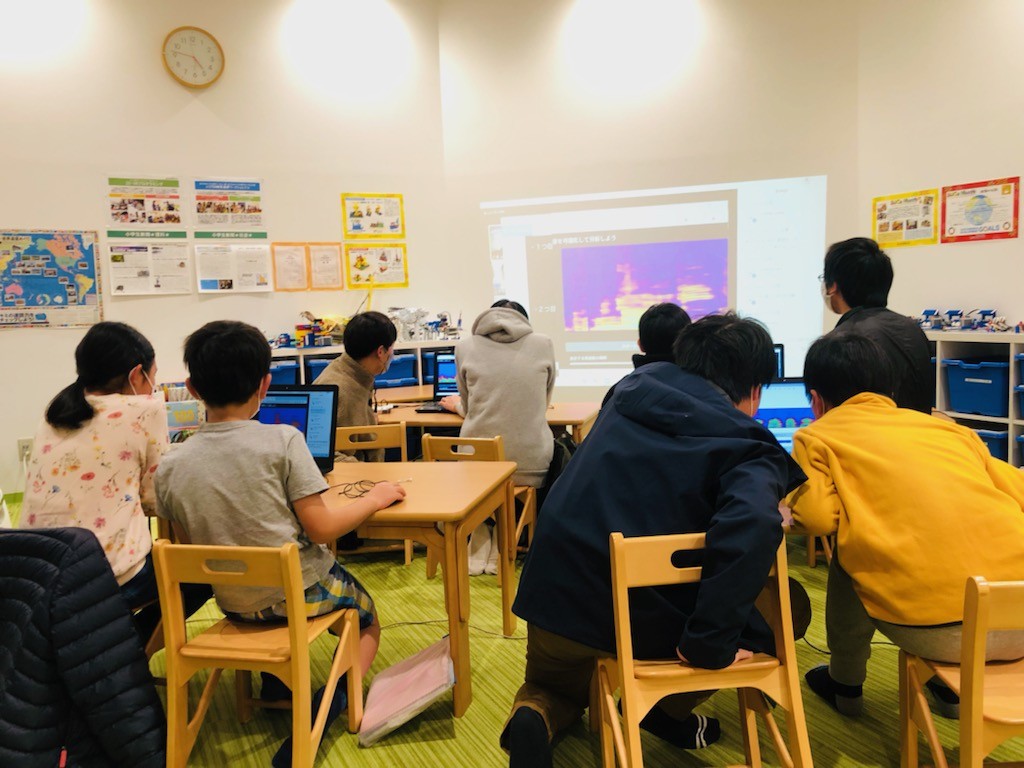
KODO Kids Station Speech-recognition programming
workshop
2022.12dec 22
Showa Gakuin Junior & Senior High School Visualize and Analyze Your Own Voice
school visit
2023.08aug 20
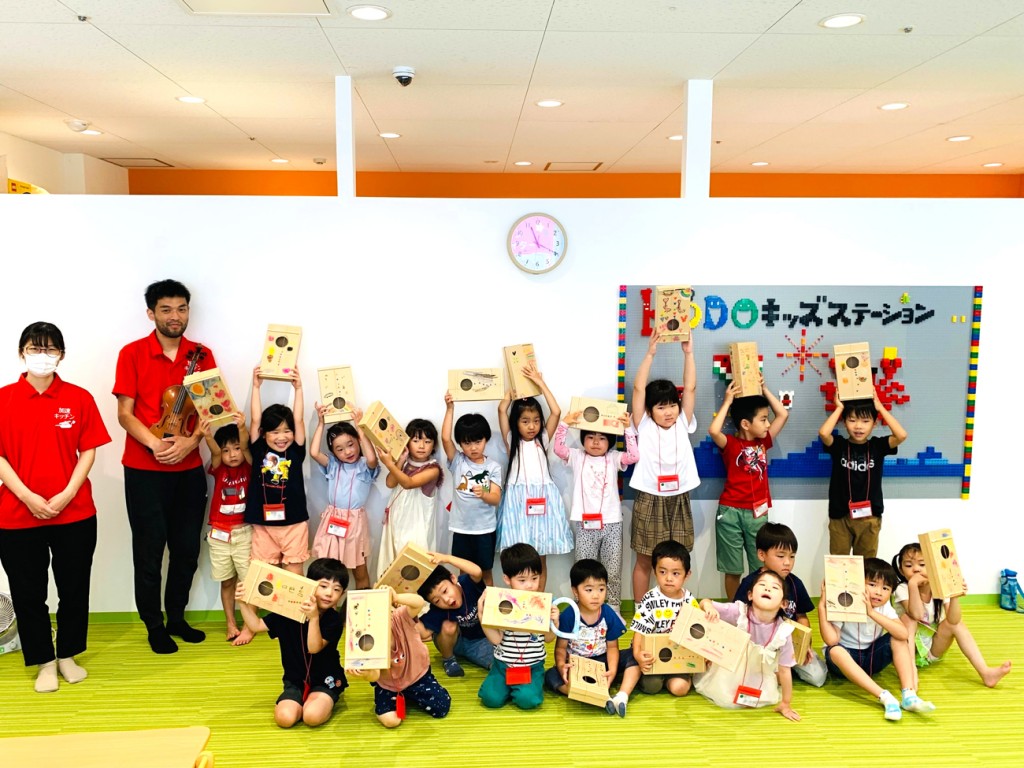
KODO Kids Station Build an instrument and break down its sound!
workshop
Scene from the 'Visualize and Analyze Your Voice' workshop at Tohoku University's Burari-gaku
Tohoku University · Burari-gaku. TOHOKU UNIV · 2019.10
Participants using the app to analyze sound during a workshop
Participants analyze sound with the app. HANDS-ON · WORKSHOP
Scene from the KODO Kids Station workshop 'Build an instrument and break down its sound!'
Build an instrument, break down the sound. KODO KIDS · 2023.08

See sound, right in your browser.

With a microphone-equipped device and a browser, you can start right away.
Feel free to get in touch about using it in lessons or inquiry activities, or about booking an on-site class.