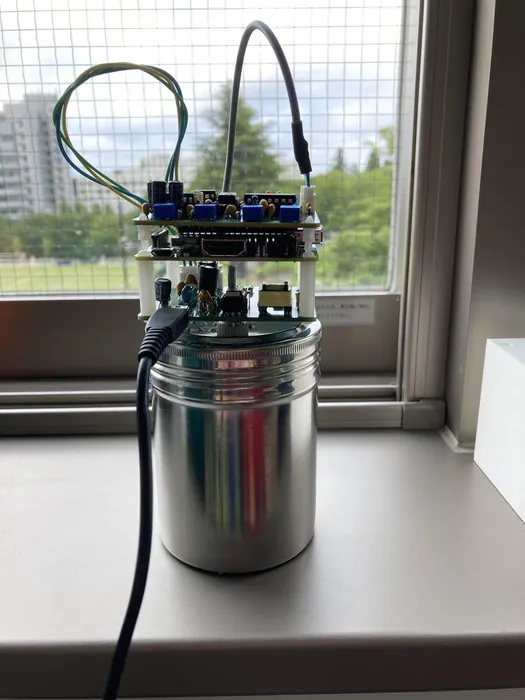

Cosmic rays reach
your living room. A program for junior-high and high-school students: measure invisible cosmic rays with a detector you build yourself, and explore your own research theme.

  • From your desk at home to the labs of research institutes
  • Gather with fellow explorers from across the country.
  • Original research that begins with cosmic rays.
0
students taking part (since 2022)
0
university-student mentors (cumulative)
0
partner sites overseas
01 after application

First, try observing cosmic rays at home.
Then move on to research on your own theme.

For the first few weeks, you get a feel for observation with a ready-made theme — the "cosmic-ray observation trial."
After that, you move on to research on your own theme.
Staff, mentors and researchers support you continuously at every stage.

1
DAY 0 ・ 5min
Send the application form
Your name, your school, and what you'd like to explore.
2
WEEK 1〜2 ・ 30min
Intake call
Online, we ask what you'd like to observe and shape a research theme together with a researcher.
3
WEEK 3〜4
Discord + your detector arrives
Connect with students nationwide on Discord. Your detector arrives at home.
4
WEEK 5~7 ・ observation trial
Cosmic-ray observation trial
Choose one of the ready-made measurement themes and try measuring and analyzing at home. ─ By here, you've got a feel for observation.
5
WEEK 8
Decide your own research theme
After the trial, you always move on to your own theme. A week to shape your question, talking it through with mentors and researchers.
6
WEEK 9~
Cosmic-ray research! (your original theme)
With mentors and researchers alongside you, start research in earnest on your own original theme.
7
twice a year ・ progress meetup
Progress meetup with peers
Twice a year, students, mentors and researchers from across the country gather to share progress and sticking points.
+ model year

An example of a year of research.

A case of presenting at a conference in year one, then an accelerator experiment and a paper submission in year two.

Apr
Apply & intake call

After applying, an online meeting with staff to hear what you'd like to explore.

May
Detector arrives & first observation

Receive the cosmic-ray detector and try measuring how the cosmic-ray rate changes with elevation angle.

Jun
Research theme decided

A theme takes shape: "Build my own Cherenkov detector and observe cosmic rays!"

Jul–Aug
Sourcing parts & a build workshop

Source acrylic parts and build your own Cherenkov detector at an in-person workshop. Plus tests with a radioactive source.

Sep–Oct
Measurement & progress meetup (online)

Measure the angular dependence of cosmic rays. Share data with students nationwide at the online meetup.

Nov–Dec
Presentation & year-end report

Present results at HSRC and write a year-end report summarizing your research so far.

Jan–Mar
Physical Society talk & in-person meetup

An oral talk at the Physical Society of Japan, and meeting peers nationwide at the in-person meetup.

May–Aug
J-PARC experiment & paper submission

Apply for and win J-PARC beam time, run the experiment, then write and submit a paper.
02 members' voices

Members' voices.

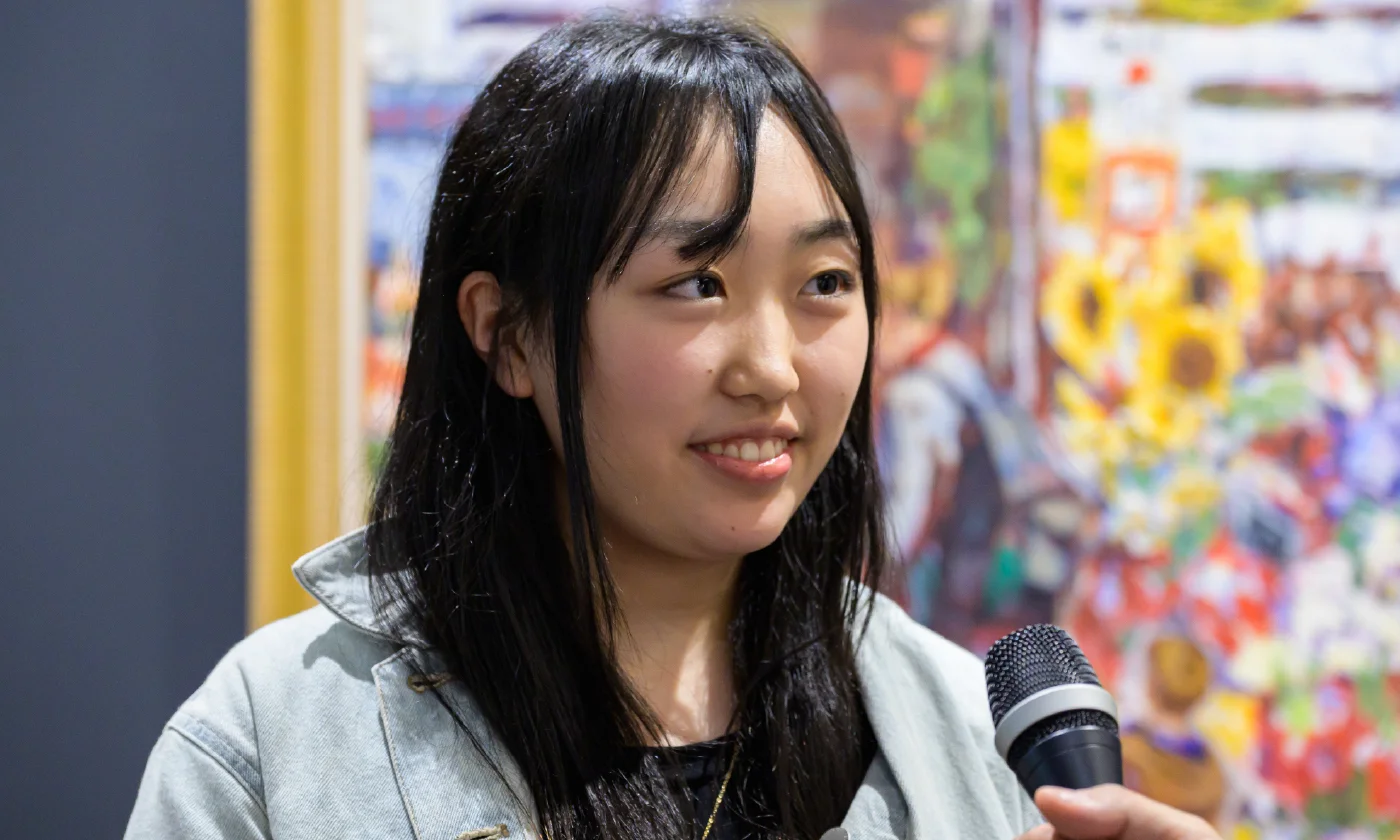
Portrait of Chihori Matsushita, a member Chihori Matsushita / Junior high 2 (2021)–High school 3 (2025) Joshi Gakuin / entering Institute of Science Tokyo in 2026
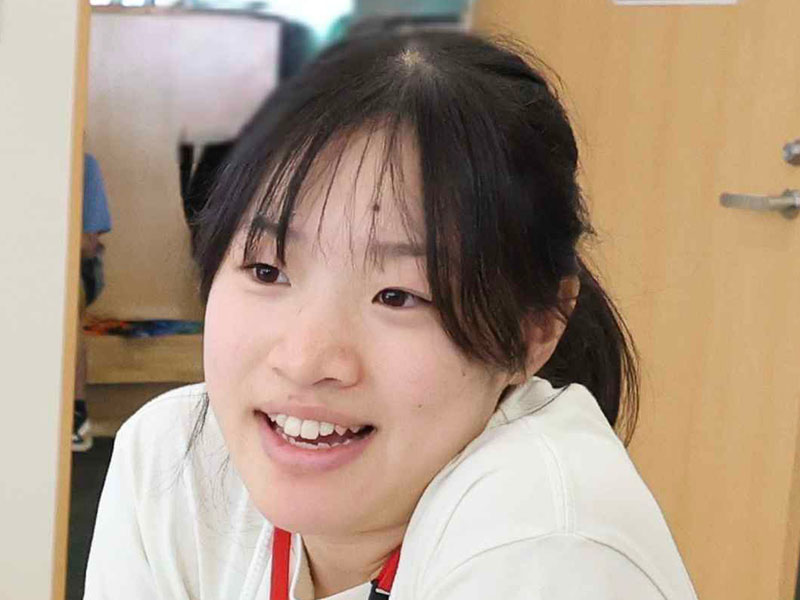
Through exhibitions and talks I got into space, and eventually learned about particles and became fascinated. As I read more, I wanted not just to know but to measure things myself — that's how it started.
Chihori Matsushita / Junior high 2 (2021)–High school 3 (2025) Joshi Gakuin / entering Institute of Science Tokyo in 2026 5 yr.
Portrait of Kanon Kawamichi, a member Kanon Kawamichi / Junior high 1 (2023)–High school 1 (2026) / Aichi / Nagoya Univ. affiliated junior & senior high
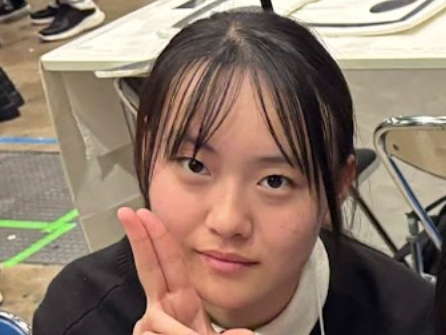
At a science museum I learned that cosmic rays pass right through my palm — "such a thing exists?!" Before joining Accel Kitchen I only knew the word "cosmic ray," but with their support I'm now enjoying measuring and researching.
Kanon Kawamichi / Junior high 1 (2023)–High school 1 (2026) / Aichi / Nagoya Univ. affiliated junior & senior high 4 yr.
Portrait of Natsume Hamamoto, a member Natsume Hamamoto / KOSEN year 1 (2024)–year 3 (2026) / Ibaraki / Ibaraki KOSEN
Being able to measure normally-invisible cosmic rays with a detector I built myself feels like a dream — it's genuinely fun. Whenever I'm stuck there are teachers and mentors I can turn to, which is reassuring; with their advice I feel I'm deepening my understanding step by step.
Natsume Hamamoto / KOSEN year 1 (2024)–year 3 (2026) / Ibaraki / Ibaraki KOSEN 3 yr.
+ field notebook

From your desk at home, all the way to research-institute labs.

From building and measuring at home to joint experiments at domestic accelerator facilities and overseas research institutes.
I
Start at home. AT HOME · WEEK 4 – 8
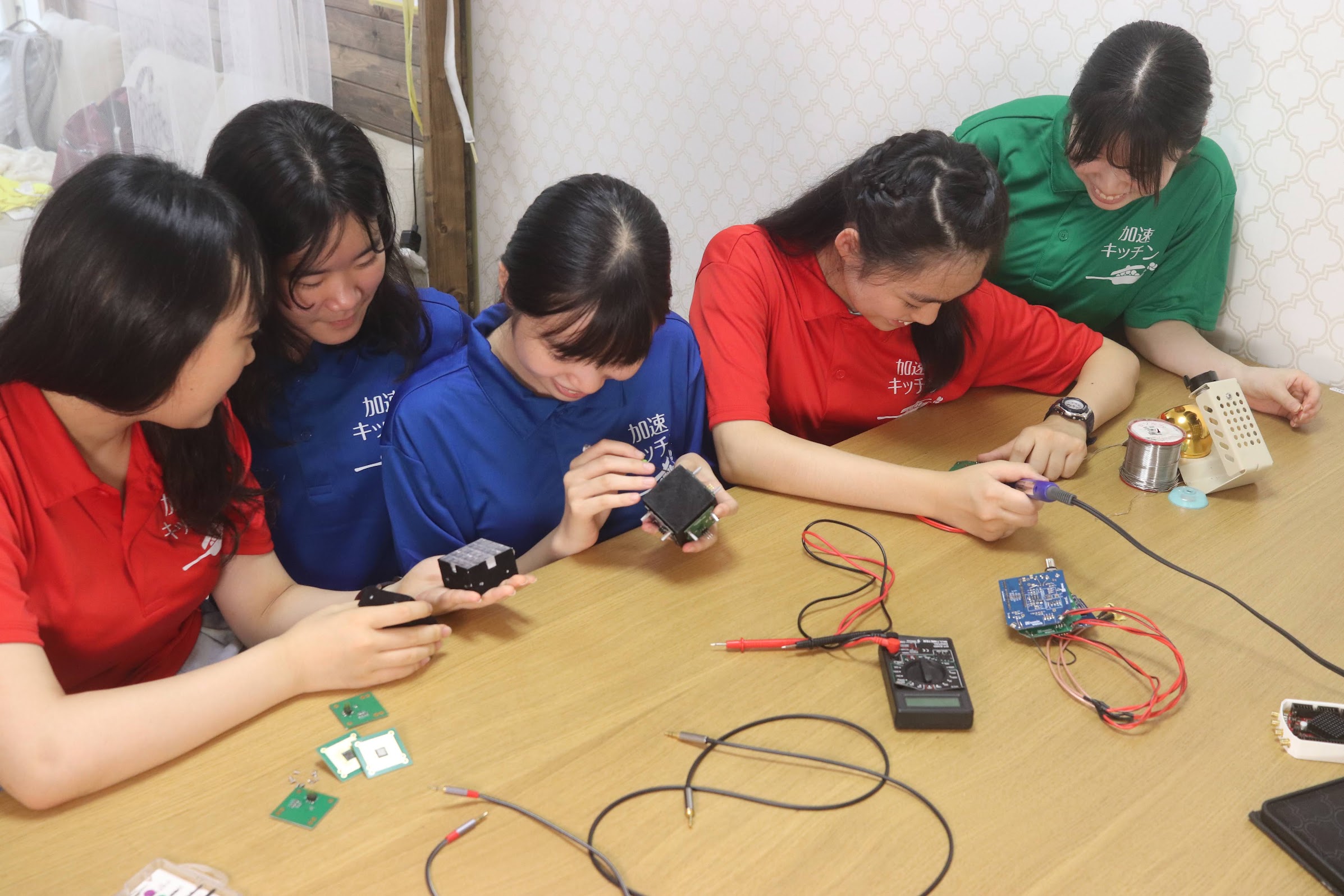
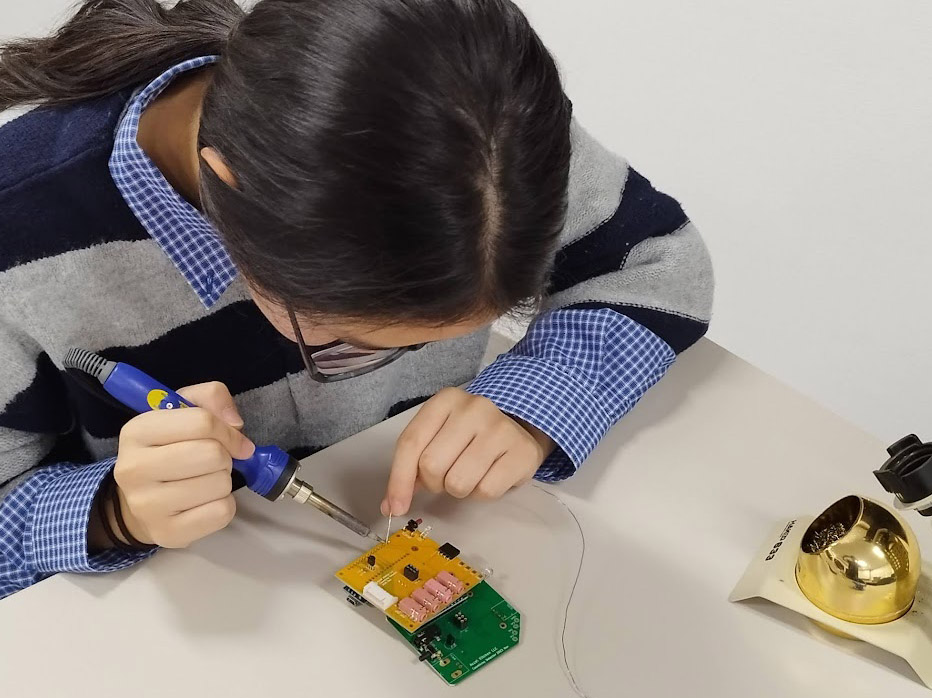
Overhead shot of a member soldering a PCB alone at a white table
Build your own detector. WK 04 · WORK BENCH
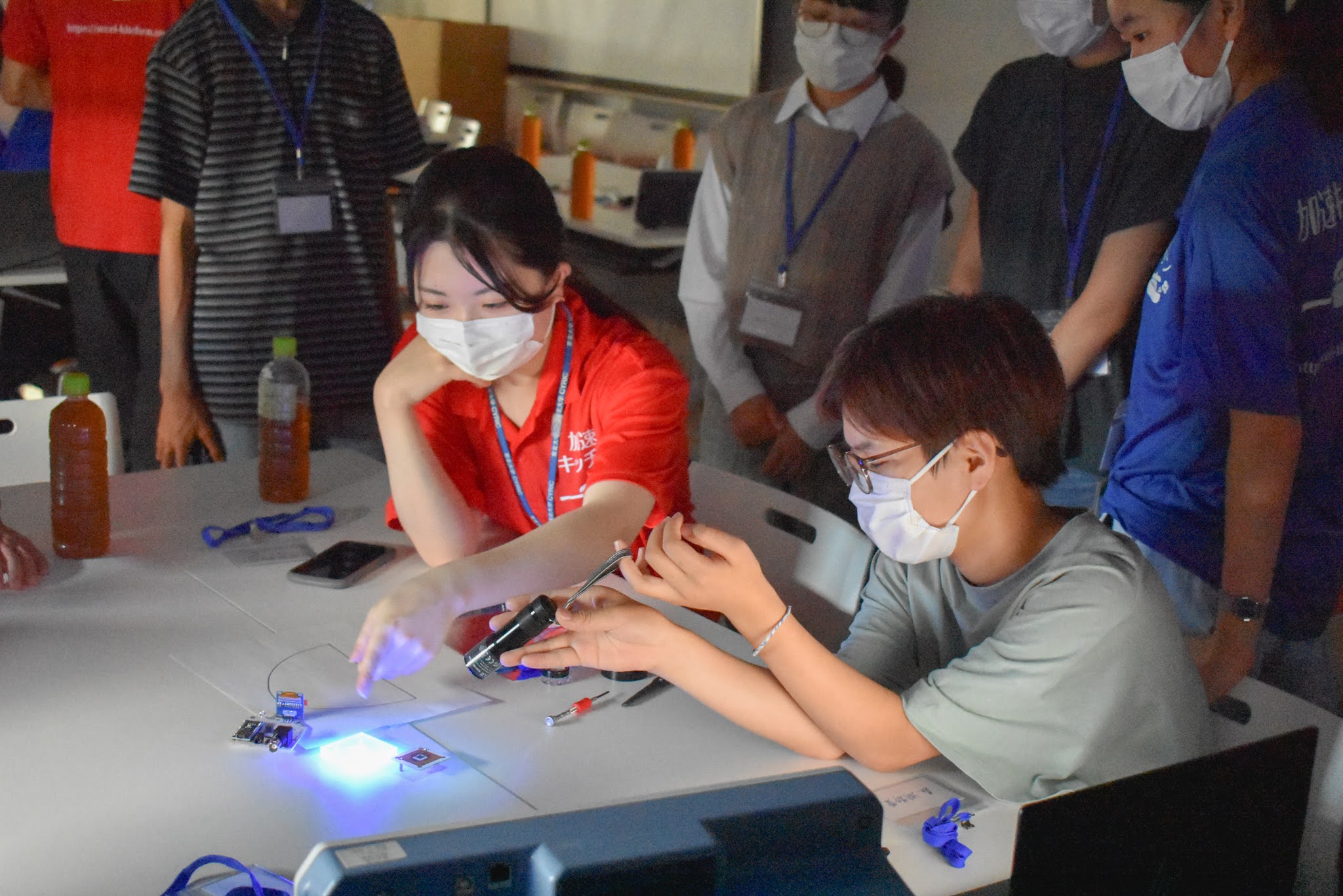
The whole team peering at the moment a scintillator glows blue
It glowed blue. WK 06 · SCINTILLATOR ON
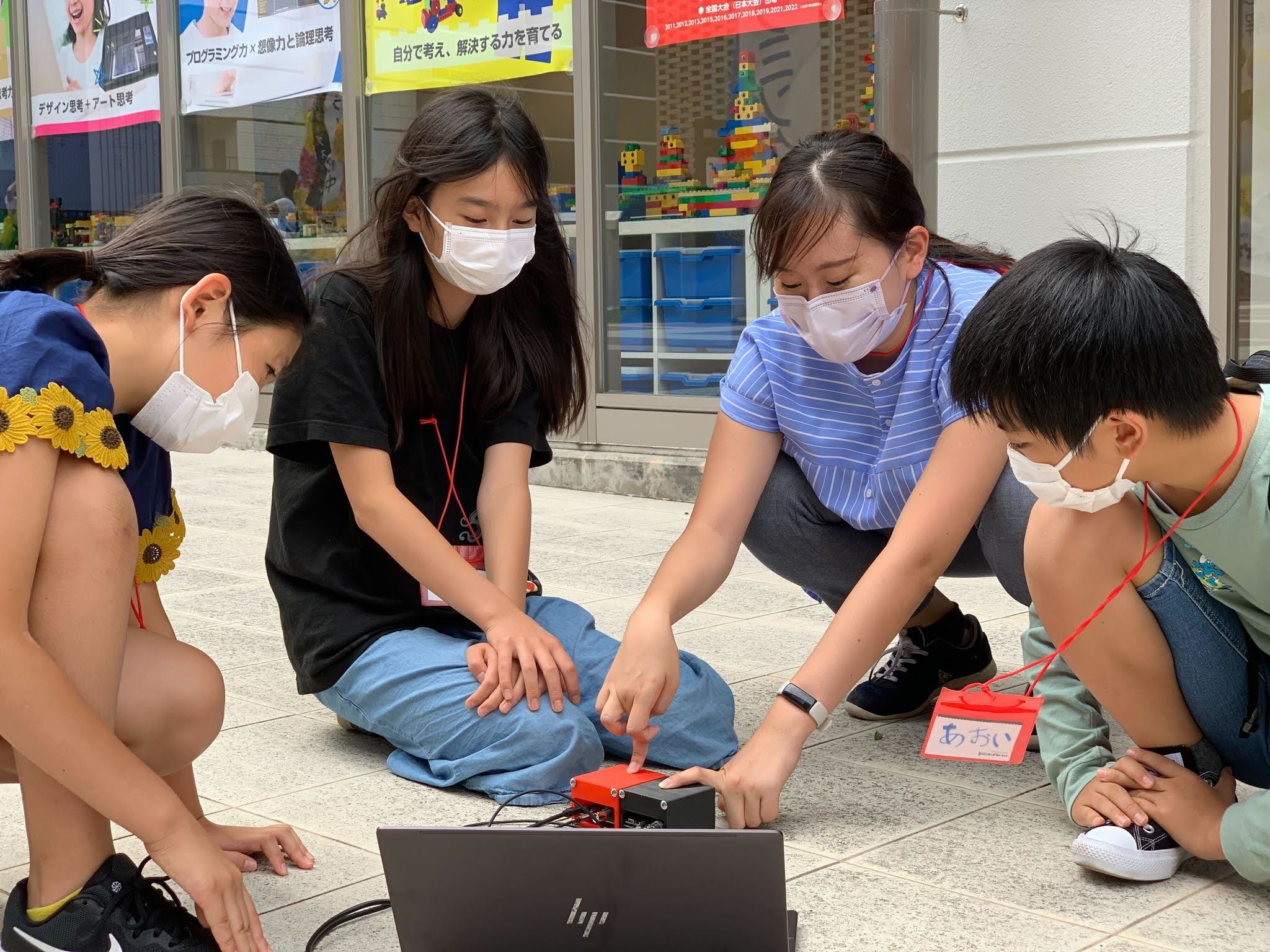
Junior-high students and a mentor crouching outdoors, measuring with a laptop and detector
Measure outdoors, too. WK 08 · OUTDOOR LOG
II
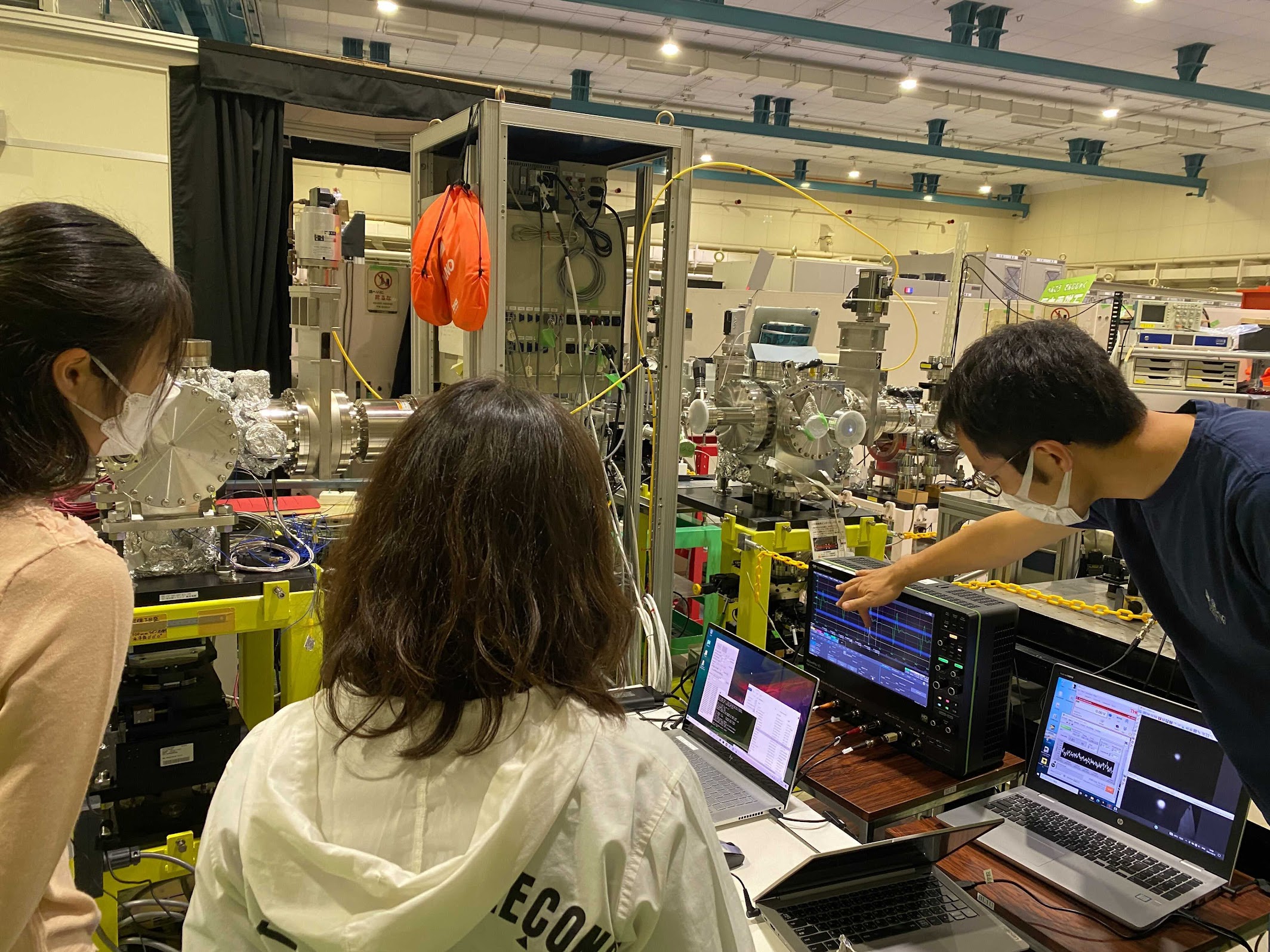
Take the detector you built to an accelerator facility. ACCELERATORS · J-PARC / UVSOR / KEK PF
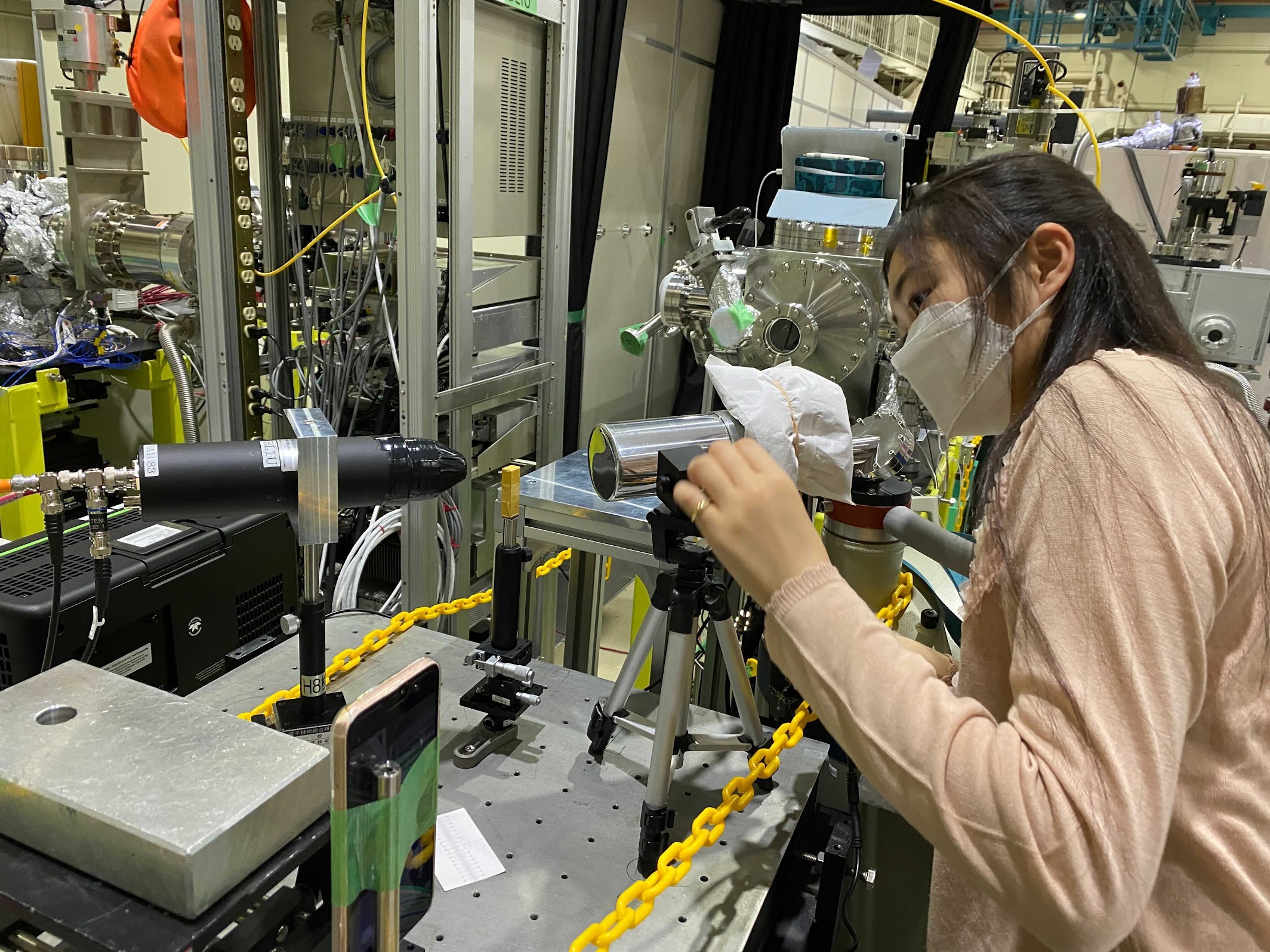
Students taking measurements at the UVSOR synchrotron-radiation facility
A synchrotron experiment at UVSOR. UVSOR · OKAZAKI · 2021.11
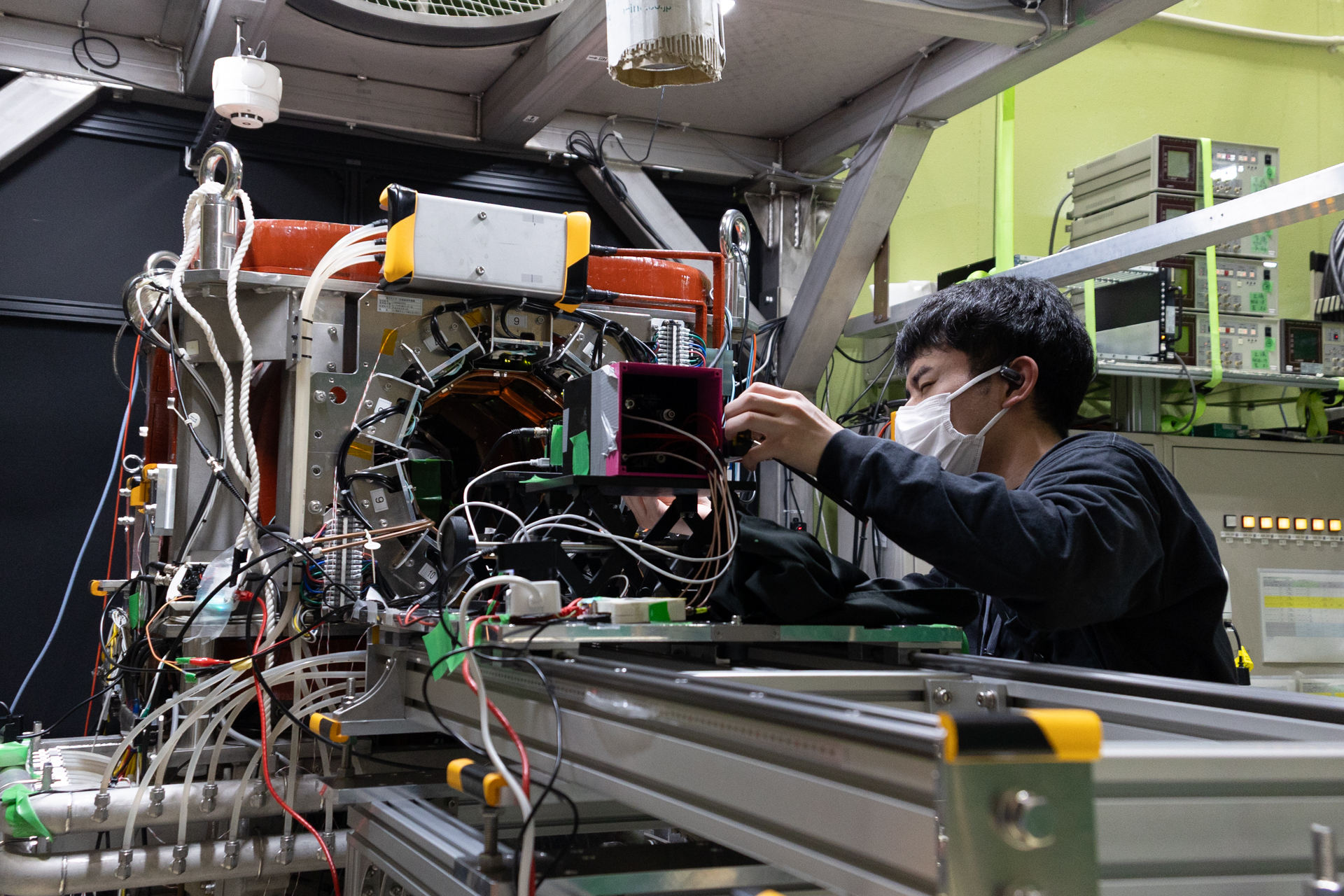
A beam experiment with a self-built detector at the KEK Photon Factory test beamline
KEK PF. Firing an electron beam at a self-built detector. KEK PF-AR TB · TSUKUBA · 2024.03
BEAM ON
High-schoolers aligning a self-built detector to the beam at a J-PARC beamline
J-PARC. Putting your own detector in the beam. J-PARC MLF · TOKAI · 2025.09
III
We collaborate with overseas research institutes, too. CERN BL4S · LANGMUIR LAB · ABROAD
CERN '25
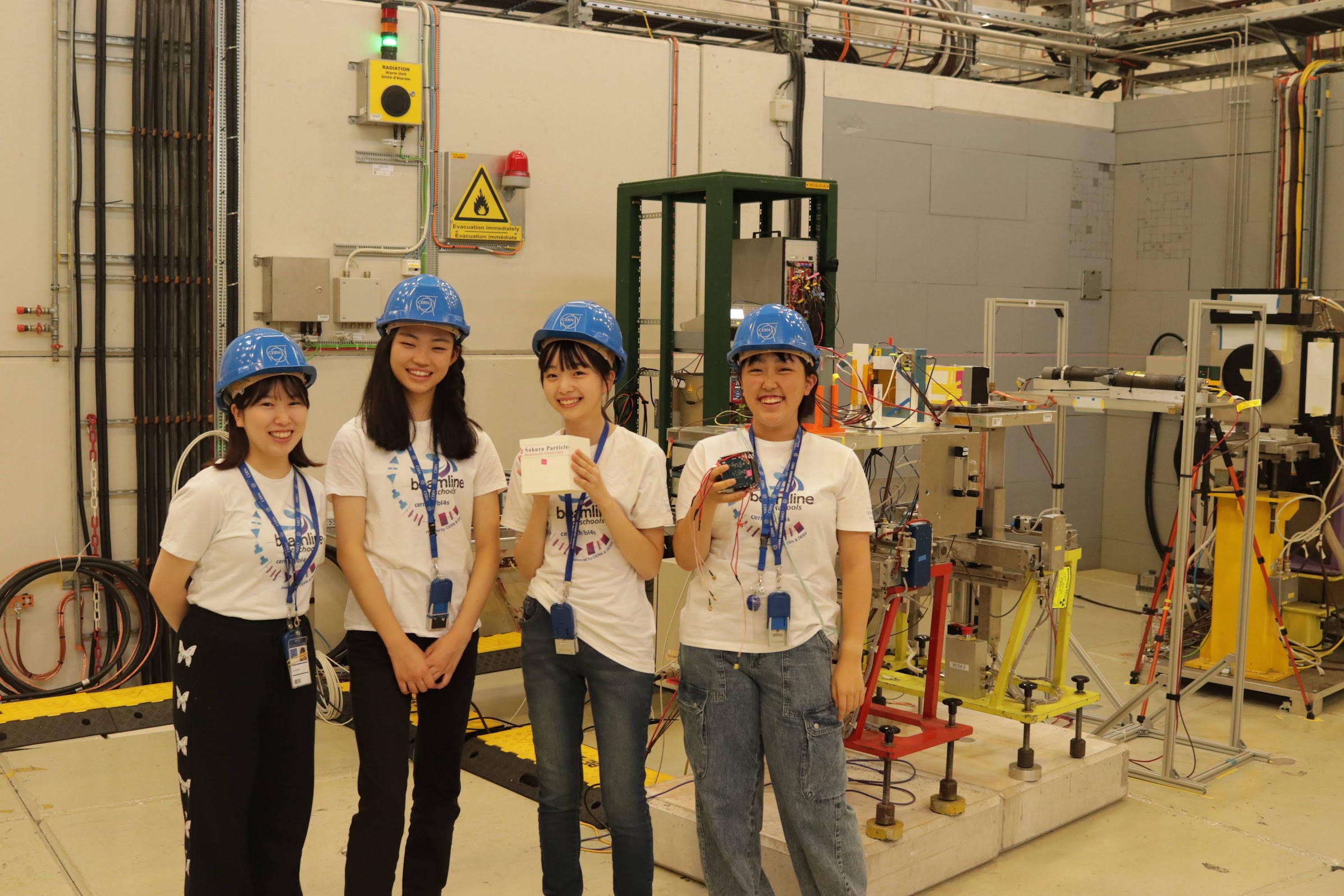
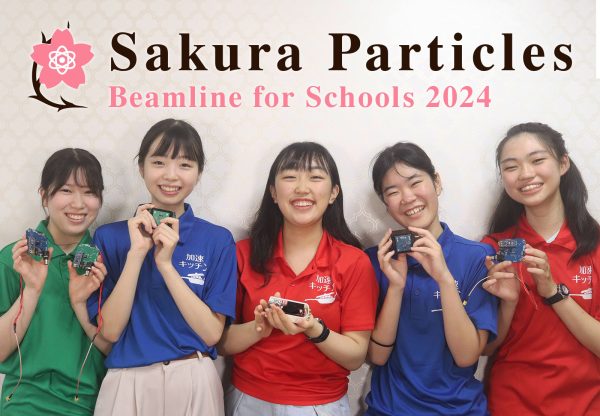
The four-member team Sakura Particles in helmets at the CERN Beam Line for Schools experiment area
Sakura Particles preparing for the experiment at a CERN beamline. CERN BL4S · MEYRIN · 2024.09 · a Japanese first
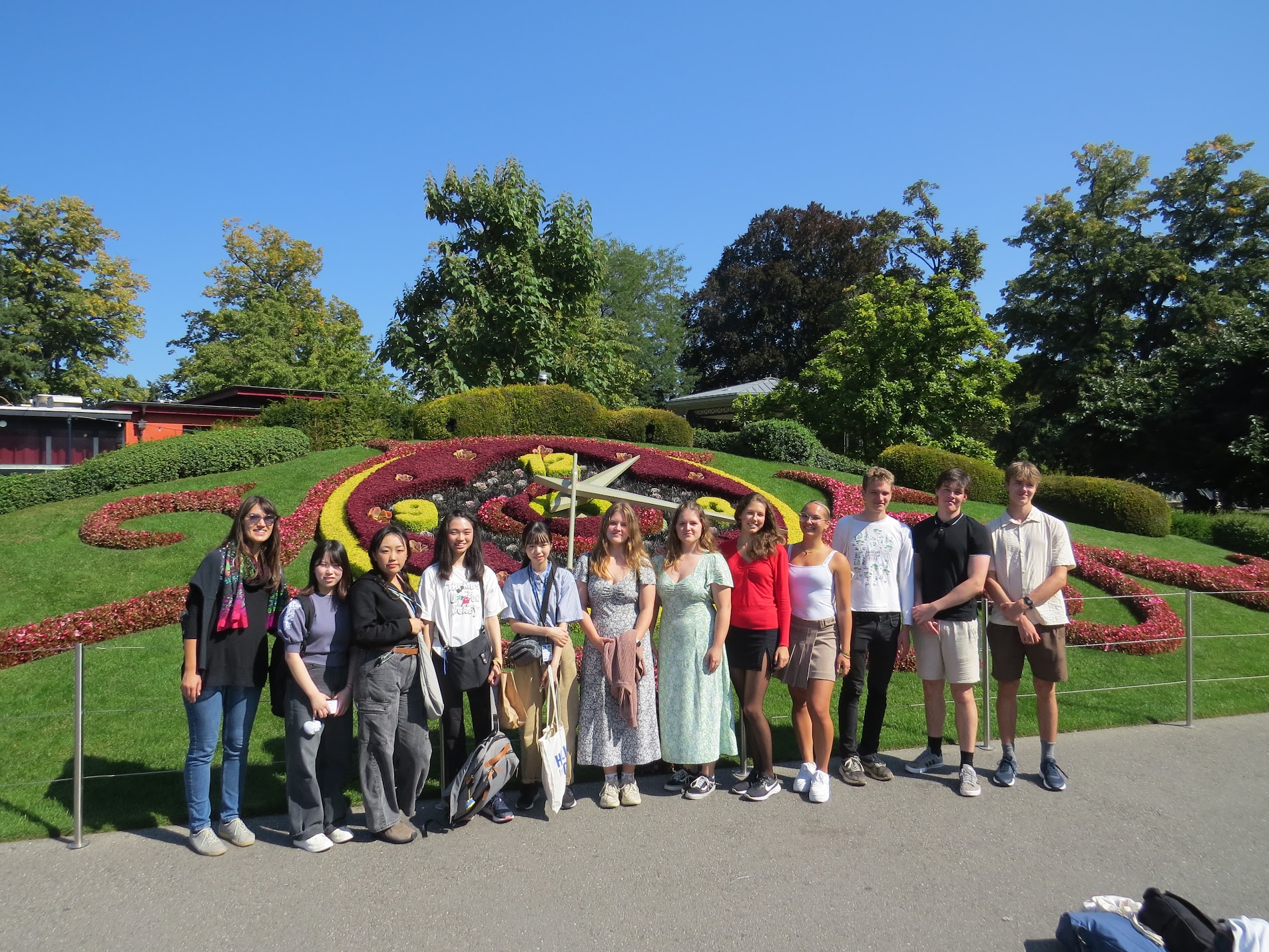
BL4S participants lined up in front of Geneva's flower clock
Sightseeing in Geneva between experiments. GENEVA · BL4S CREW · 2024.09
3,200 m
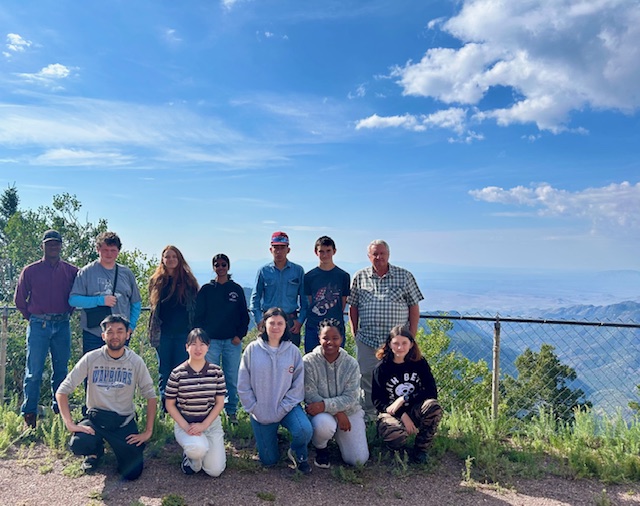
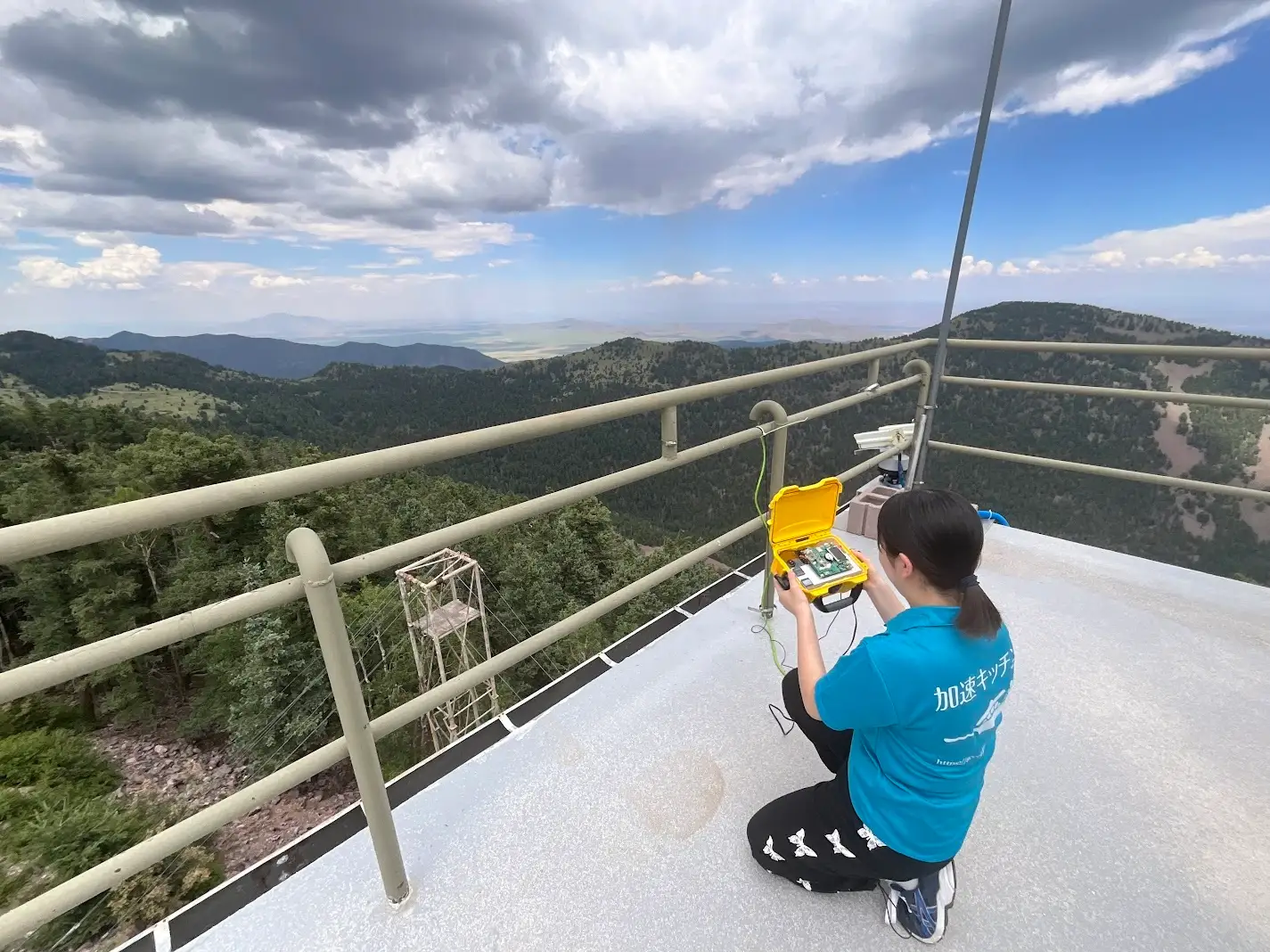
Japanese and local high-schoolers gathered on a summit for thundercloud gamma-ray observation at Langmuir Lab, New Mexico, USA
Thundercloud gamma-ray observation on a 3,200 m peak in New Mexico, USA. LANGMUIR LAB · NEW MEXICO · 2024
IV
Gather with fellow explorers nationwide. MEET-UP · TWICE A YEAR
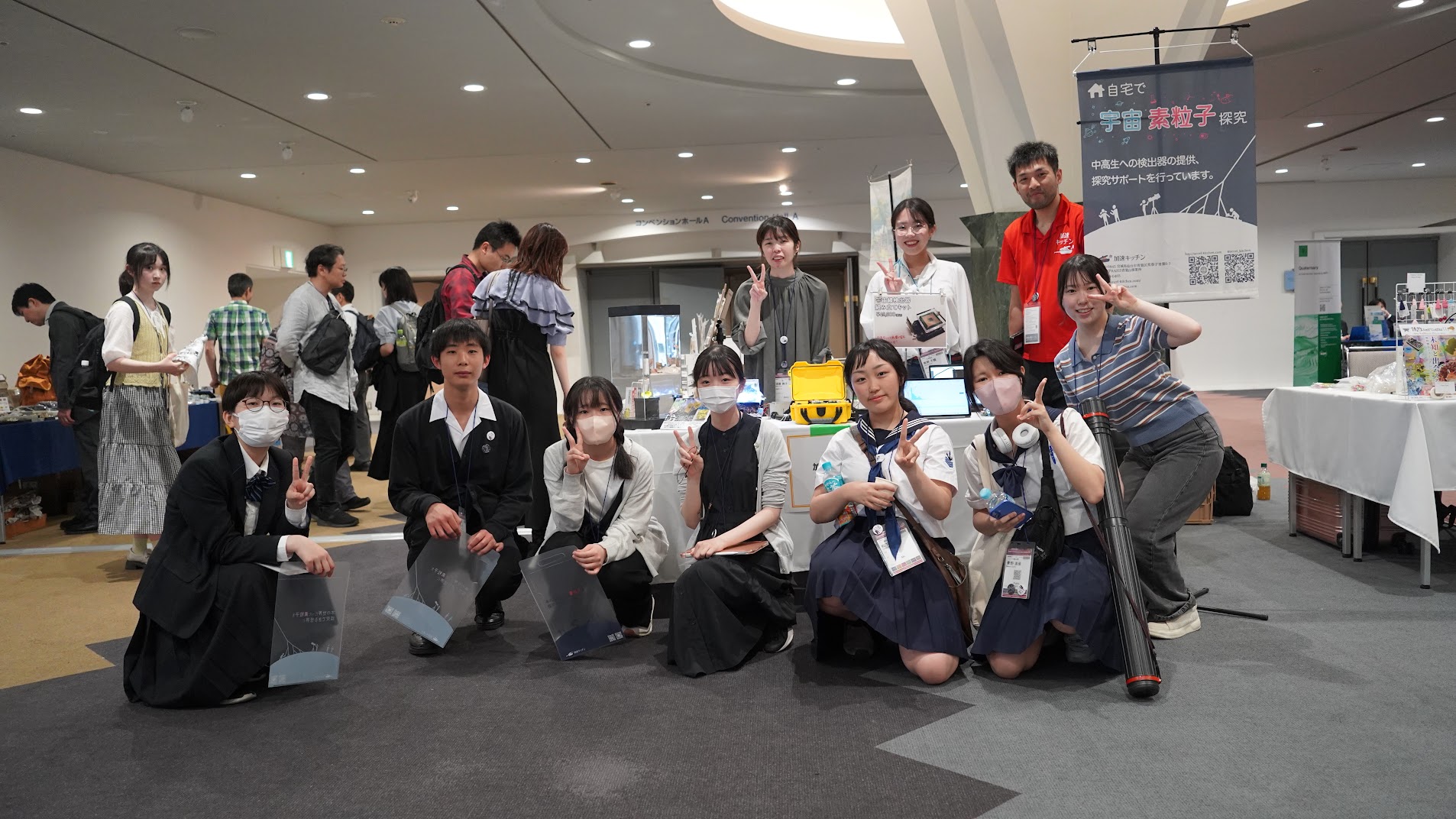
A twice-a-year meetup where cosmic-ray explorers gather from all over Japan. PROGRESS MEET-UP · WATCH · TOKYO
A member presenting at a progress meetup
Members who gave a poster presentation at JpGU. JpGU2025・MAKUHARI MESSE・2025.05
V
Original research that begins with cosmic rays. RESEARCH OUTCOMES · 2022 –
New Mexico thundercloud gamma-ray observation, Langmuir Lab collaboration
'24.11 Thundercloud gamma-ray observation, New MexicoLangmuir Lab collaboration
CERN Beamline for Schools contest, Sakura Particles
'24.08 Selected for CERN's Beamline for SchoolsSakura Particles / a Japanese first
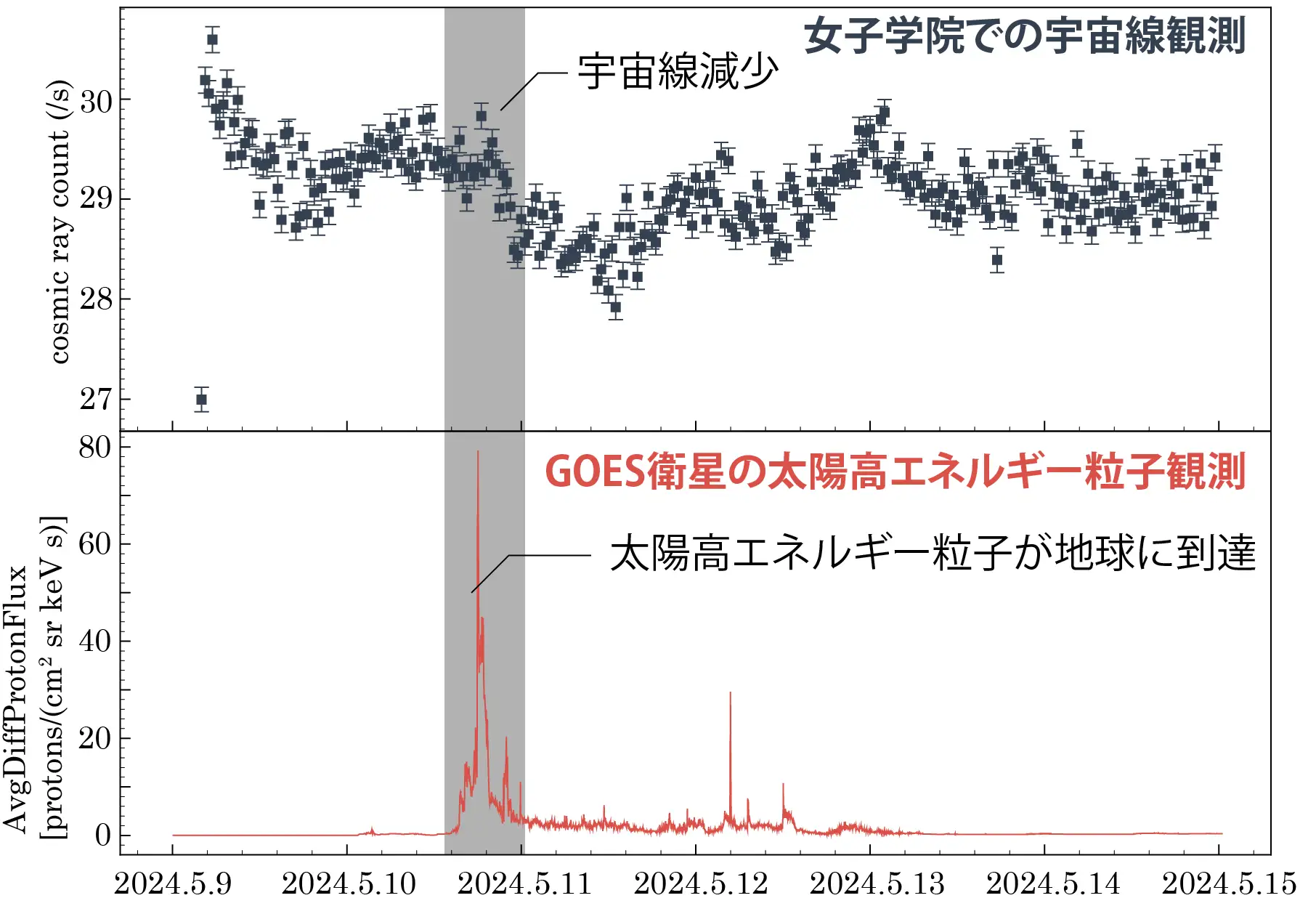
Ground observation of solar flares, Forbush decrease, Joshi Gakuin research project
'24.08 Ground observation of solar flares (Forbush decrease)Joshi Gakuin · research project
Proton-therapy dose monitor development, Kawagoe Girls' SSH presentation
'23.06 Proton-therapy dose-monitor developmentKawagoe Girls' · SSH presentation
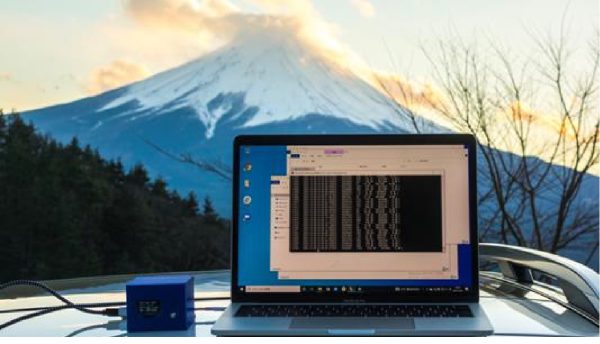
Cosmic-ray measurement atop Mt. Fuji, Kaisei High School research project
'22.10 Cosmic-ray measurement atop Mt. FujiKaisei High School · research project
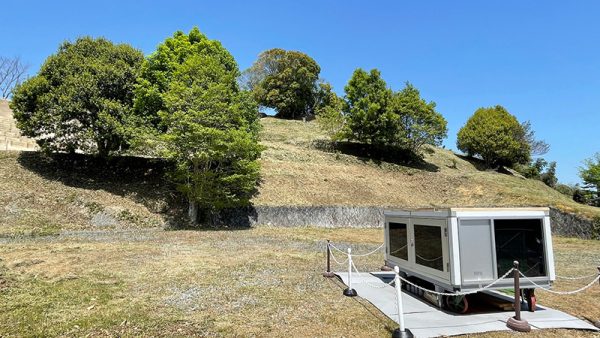
Burial-mound muography collaboration, Teikyo Univ. Kani High School
'22.03 Burial-mound muography collaborationTeikyo Univ. Kani High School
Beyond Cosmic Rays You can explore the “radiation” around you, too.
Gamma-ray observation with a homemade scintillator, scintillation-light imaging with an everyday camera, natural radioisotopes hiding in rocks — a collection of students' radiation-research examples.
See radiation-research examples →
+ detectors

The detectors you can use.

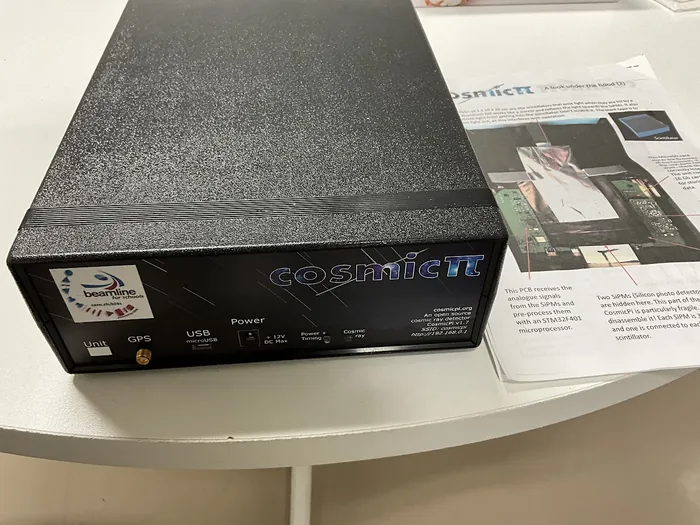
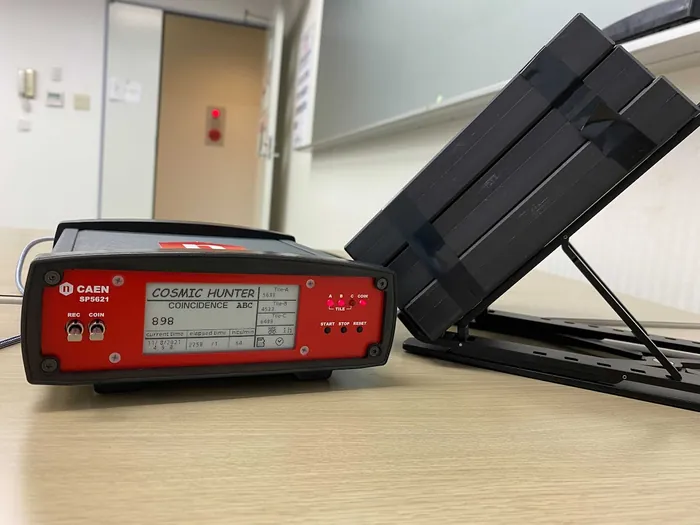
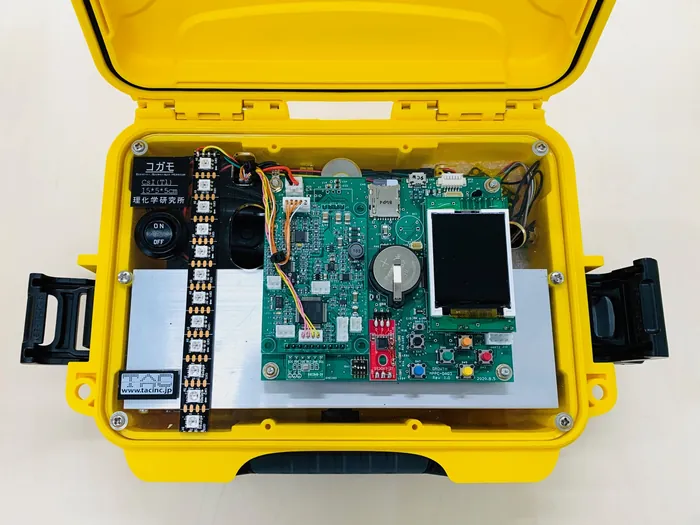
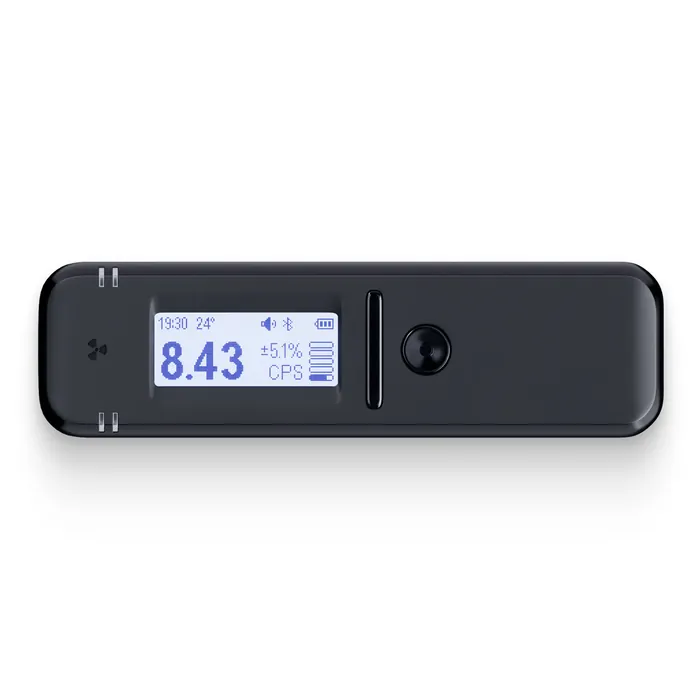
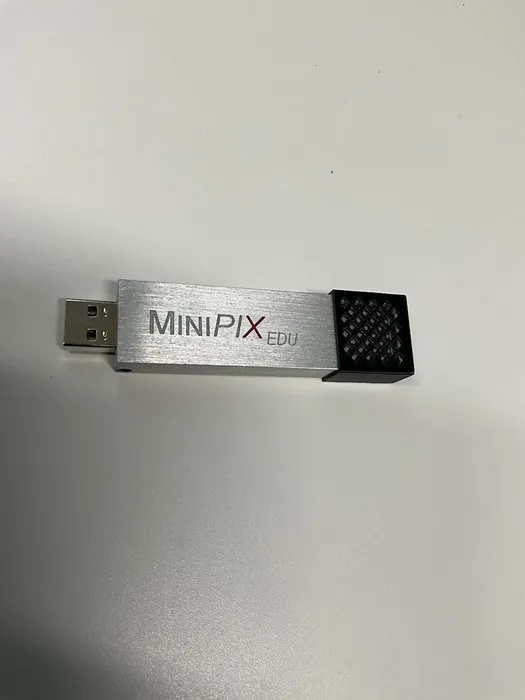
Beyond the detectors Accel Kitchen builds and develops, we lend out a wide range — from commercial units to ones used in real research. Counting muons, measuring gamma rays, imaging particle tracks: you can use their different strengths to design your own research theme.

See other detectors
+ endorsed by researchers

Supervising researchers & partner institutions

Researchers in radiation- and particle-related fields support us as advisors.
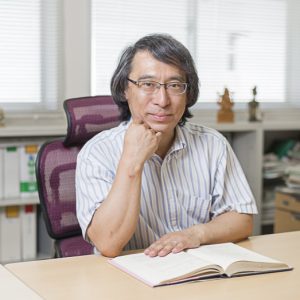
Portrait of Prof. Yasuhiro Sakemi (Center for Nuclear Study, University of Tokyo)
Nuclear physics

Yasuhiro SakemiSakemi Yasuhiro

Graduate School of Science, University of Tokyo
Center for Nuclear StudyProfessor / Director

“ The particle- and nuclear-physics research students do at Accel Kitchen is of high academic value, and a precious chance to touch cutting-edge science. ”

By immersing themselves in serious research — building instruments and more — students can take a first step toward becoming physicists who will carry the future of basic science.
Y. Sakemi University of Tokyo / Center for Nuclear Study
Portrait of Prof. Koji Watabe (CYRIC, Tohoku University)
Medical radiation

Koji WatabeWatabe Koji

Tohoku University
Cyclotron and Radioisotope CenterProfessor / Director

“ Accel Kitchen was born at Tohoku University's Cyclotron and Radioisotope Center, and we have collaborated since FY2022 on student radiation research. ”

Experiments using our large cyclotron accelerator and more will be a precious opportunity for students.
K. Watabe Tohoku University / Cyclotron & RI Center
supporting institutions
International beamline experience
Beam Line for Schools

Co-hosted by CERN & DESYcern.ch / bl4s
Research partner
CYRICTohoku University

Cyclotron and Radioisotope CenterTohoku University

International outreach
IPPOG

International Particle Physics
Outreach Groupsince 1997

Funding body
Mitsubishi Mirai Ikusei Foundationgeneral incorporated foundation

Funds this program's operating costsMitsubishi Mirai Ikusei
04 across japan

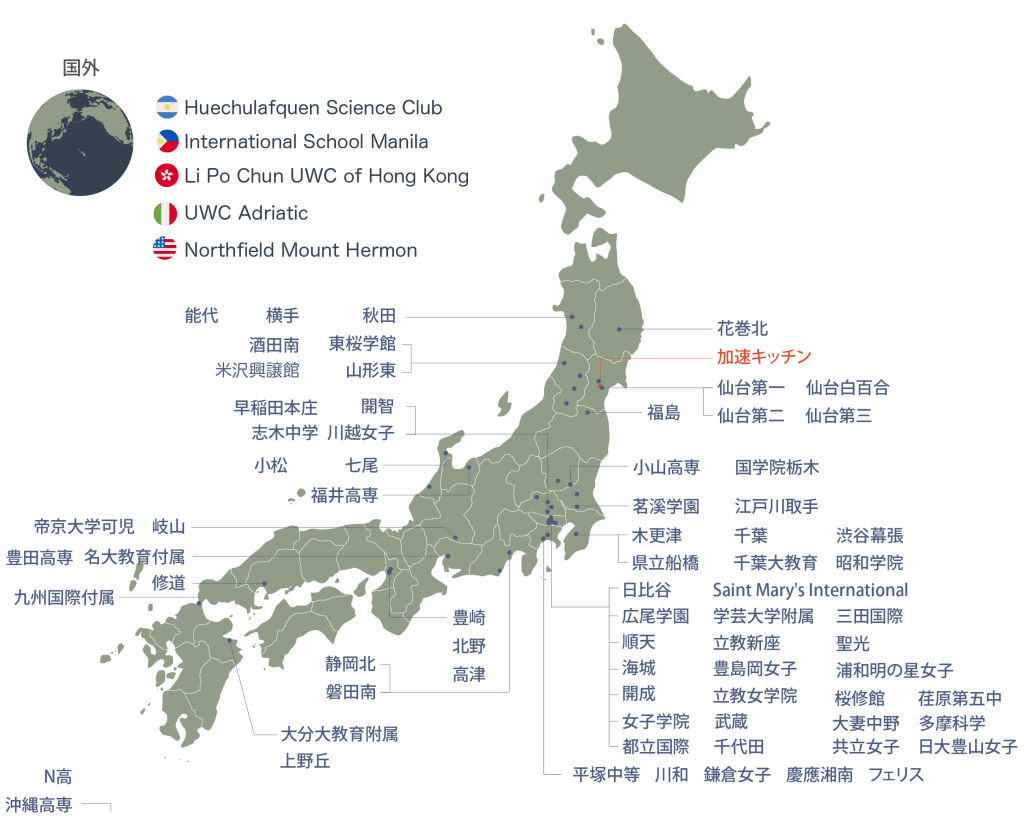
Participating schools span 21 prefectures and 76 schools.

21/47
prefectures
From Hokkaido to Okinawa — including students living overseas.
53%
public-school share
Not just private prep schools — many local public schools and KOSEN take part too.
Observation notebook · map of participating schools updated 2026.04.21 · points 76
Map of participating schools across the 47 prefectures
05 for parents & teachers

For parents & teachers

We've summarized the information you need to decide — cost, safety, balancing with entrance exams, how schools are involved, and more — for both parents and teachers.

For Parents

For parents

  • Why it's completely free (funded by the Mitsubishi Mirai Ikusei Foundation)
  • Mentor identity, communication environment, and our personal-data policy
  • Handling of equipment, and rules for the unlikely event of damage or loss
  • Balancing with entrance exams (activity frequency, the option to pause, flexible extensions)
See details for parents
For Teachers

For teachers & club advisors

  • Participation is individual by default (no school approval or oversight required)
  • How to fold "cosmic-ray research" into SSH and research-project themes
  • Using the activity record for career guidance and recommendation letters
  • Adopting it as a school program (paid; please inquire)
See details for teachers & advisors
06 frequently asked

Q and A

Q.01 Is it really okay to start with zero knowledge? +
Yes. In fact, most people start from zero.
"cosmic ray," "scintillator" — if these words come up and leave you thinking "what's that?", there's no need to memorize them now. For the first three months you don't have to learn the terms by heart. As you build the detector with your hands and catch particles at home, the words you need sink in naturally.

You can talk with mentors every day on Discord. Just saying "I don't get it" is enough to move forward. Even if you're weak at physics or it's beyond the textbook, here research begins from "not knowing" — that's the spirit of this program.
Q.02 Can I balance it with club activities and exam study? +
Measuring and analyzing at home is the core, so you can make progress in your free time. The biweekly 30-minute mentoring can be scheduled whenever suits you and your mentor. You can prioritize exam periods and club tournaments, take breaks, and go at your own pace.
Q.03 What do I need? And the cost? +
It's completely free (funded by the Mitsubishi Mirai Ikusei Foundation). Accel Kitchen lends and provides the detector, parts and software. All you need is an internet connection and one computer.
Q.04 What if I want to stop partway? +
You can pause or leave anytime. We'll explain how to return the detector online.
If it turns out not to be a fit, leaving requires no special paperwork. You can also pause temporarily for exams or club commitments — just let us know what works for you.
Q.05 How is the chance to run an accelerator experiment decided? +
Once or twice a year we put out a call for experiment proposals among Accel Kitchen groups and select from them. Even students unfamiliar with accelerators can write a proposal with their mentor's support.

About applying

It takes about five minutes. No detailed statement of purpose is needed — just your name, school and what interests you.
For the first few weeks you practice observation with a ready-made theme, then move on to research on your own theme.
Ask on LINE