To members of the press
Accel Kitchen wins Tohoku University’s Sawayanagi Memorial DEI Award
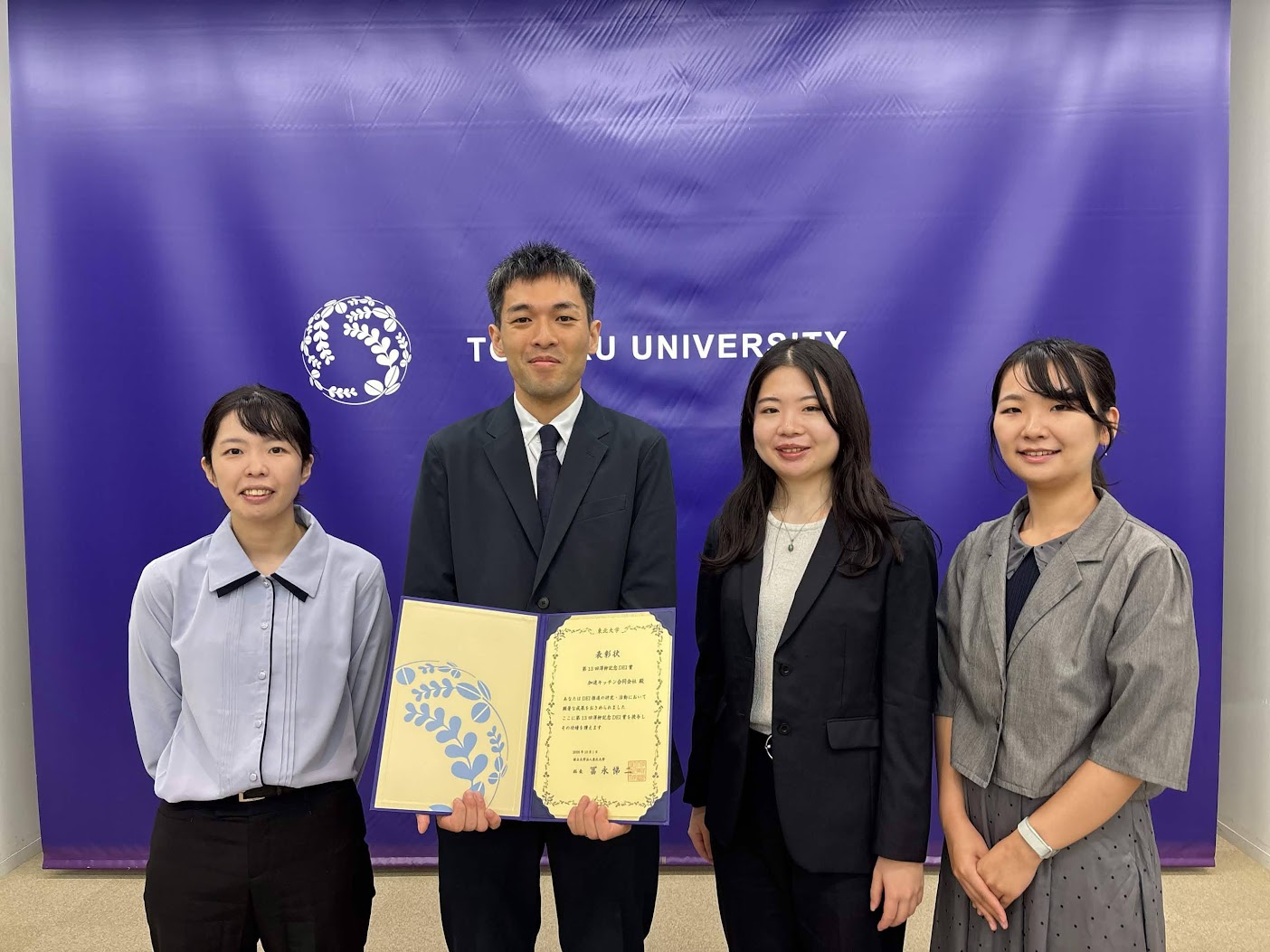
Accel Kitchen LLC (founder: Kazuo Tanaka) has received Award A, the “Sawayanagi Memorial DEI Award,” of Tohoku University’s 13th (FY2026) Sawayanagi Memorial DEI Award. The recognised project is “Opening the door to particle-physics inquiry for blind and visually impaired students and for junior- and senior-high girls.” The award honours the work of building an environment in which students can take part in particle-physics research regardless of gender, disability, region, economic circumstances or nationality. An award ceremony and lecture were held at Tohoku University on 1 October 2026, where Accel Kitchen received the certificate.
- Award
- The 13th (FY2026) Sawayanagi Memorial DEI Award, Award A
- Project
- Opening the door to particle-physics inquiry for blind and visually impaired students and for junior- and senior-high girls
- Recipient
- Accel Kitchen LLC
- Ceremony & lectures
- Thursday 1 October 2026, from 10:00Espace, 2F Katahira North-Gate Hall, Tohoku University (Katahira Campus, Sendai) / hybrid, with Zoom
- Organisers
- Diversity, Equity, and Inclusion (DEI) Promotion Committee and Center for DEI, Tohoku University
- Related pages
- Tohoku University DEI Center: event report (in Japanese; posted 19 October 2026)
About the Sawayanagi Memorial DEI Award (in Japanese)
An award named for the “open door” principle
Guided by the “open door” (monko kaiho) principle set out by its first president, Masataro Sawayanagi, Tohoku University admitted women to an imperial university ahead of the rest of the country in 1913. The Sawayanagi Memorial DEI Award takes its name from that first president. It honours individuals and groups, inside or outside Tohoku University, that have made a major contribution to promoting diversity, equity and inclusion (DEI) — including gender equity — in academia and society, and aims to help that work grow further.
There are two categories: Award A (Sawayanagi Memorial DEI Award), for an individual or group with exceptionally outstanding results in DEI-related research or activities, and Award B (Sawayanagi Memorial DEI Encouragement Award), for a young individual (aged 42 or under) or a group that started its activity within the last five years. In the 13th round, Accel Kitchen received Award A, and Madoka Nakano, Associate Professor at the Center for Coproduction of Inclusion, Diversity and Equity (IncluDE) at The University of Tokyo, received Award B for editing the book Nihon de Josei Kenkyusha ga Fuenai Riyu (“Why the number of women researchers is not growing in Japan”) and for her contribution to IncluDE.
Five activities, run as one system
Tohoku University’s review comments highly rate Accel Kitchen for building, in a field of particle-physics research that has so far stayed within a limited number of universities and institutes and out of students’ reach, an environment where any student can take up genuine research, regardless of background. The foundation they point to is that the following five activities are run together as one.
-
Lending particle detectors to individual students
Detectors for cosmic rays and other particles are lent to junior- and senior-high students free of charge, so they can measure at home. More than 300 have been lent out to date. About the program
-
Developing inclusive particle detectors
With the Special Needs Education School for the Visually Impaired at the University of Tsukuba and Dialogue in the Dark, Accel Kitchen developed a “cosmic-ray detector that conveys energy through sound” and ran demonstration lessons at a school for the blind. At Science Agora 2026 it also showed five ways to feel a cosmic ray: mist, electrical signal, sound, light and vibration. Exhibit report · Media coverage
-
Supporting joint research between students and researchers
Work by the high-school team “Sakura Particles” has been published in the journal NIM-A, and Yuzuka Sasaki’s study in Physics Education (IOP Publishing). The NIM-A release · The Physics Education release
-
Student experiments at accelerator facilities, including overseas
In June 2026, eleven junior- and senior-high students ran muon-beam experiments at J-PARC on five themes they devised themselves. At CERN’s Beamline for Schools, an Accel Kitchen team became the first from Japan to win the grand prize. The J-PARC release
-
An international network
Between July and August 2026, Accel Kitchen visited Senegal, Brazil, Argentina and the Dominican Republic, ran workshops at host universities and installed six cosmic-ray detectors. The four-country release
The review comments single out the effort to open particle-physics research to blind, deaf and hard-of-hearing students as highly original even by world standards. They also cite a research community in which about 70% of participating students and mentors are women, rare in this field; genuine academic output, including a talk at JpGU 2024 and submissions to peer-reviewed journals; and a self-sustaining cycle in which students return as mentors for the next generation after moving on to university.
The award ceremony and lectures
The ceremony and award lectures began at 10:00 on Thursday 1 October 2026 at Espace in Katahira North-Gate Hall on Tohoku University’s Katahira Campus, with online participation over Zoom. Tohoku University reports that 73 people took part, in person and online.
In the award lectures that followed the ceremony, Accel Kitchen’s founder Kazuo Tanaka spoke under the title “Opening the door to particle-physics inquiry for blind and visually impaired students and for junior- and senior-high girls.” Madoka Nakano, who received Award B, then gave her lecture.
The two go back a long way: during their university days, Nakano and Tanaka worked together on “Todai Guidance” (Todai Gaidansu), an initiative to close the information gap for high-school students hoping to enter the University of Tokyo. Years later, they were honoured side by side in the same round of the award.
- Opening remarks
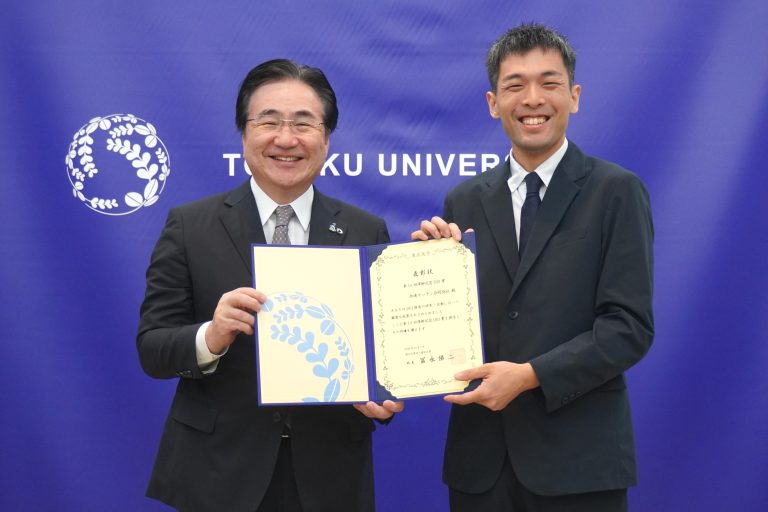
- Teiji Tominaga, President of Tohoku University
- How the awards were decided
- Rie Umetsu, Vice-Chair of the DEI Promotion Committee (Special Advisor to the President for DEI)
- Award presentation
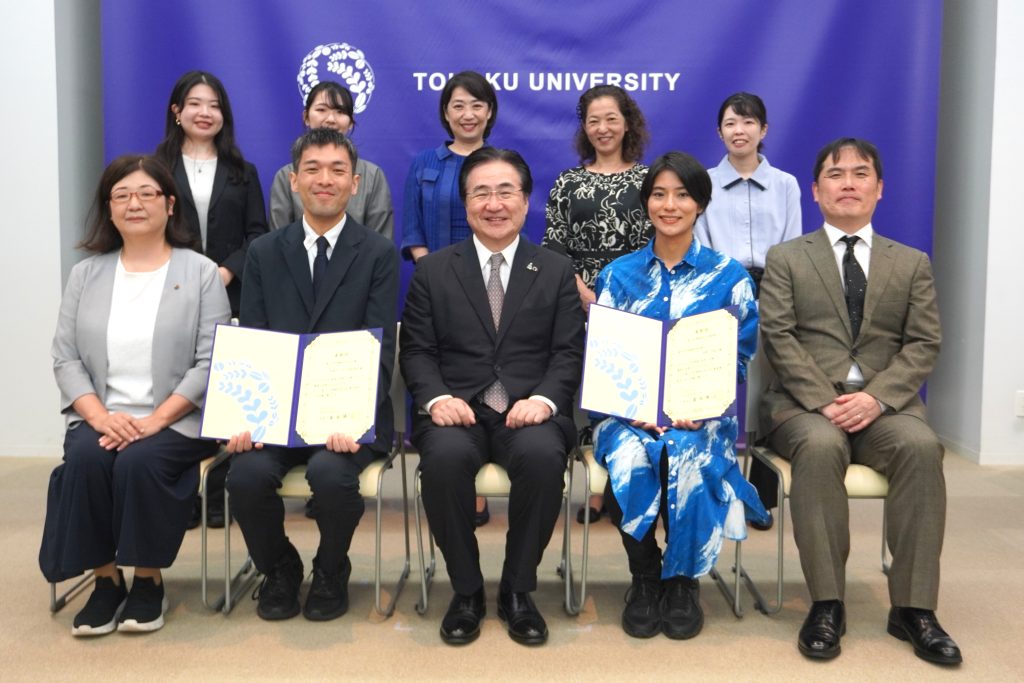
- Award A: Kazuo Tanaka, Accel Kitchen LLC
Award B: Madoka Nakano, Associate Professor, IncluDE, The University of Tokyo - Award lectures
- Kazuo Tanaka (Accel Kitchen) / Madoka Nakano
- Closing remarks
- Mami Tanaka, Vice President (Diversity) and Director of the Center for DEI, Tohoku University
Keep widening the doorway
We take this award as recognition of work carried out together with the students who take up inquiry, the university and graduate students who mentor them, parents and teachers, and the research institutes and organisations that collaborate with us on joint research and demonstration lessons. We are deeply grateful to every one of them.
Accel Kitchen will keep working so that the exploration of particles and the universe stays open to students of every background and circumstance. Among other things, we will take this recognition as encouragement to refine vibration output — which visually impaired visitors at Science Agora 2026 told us they could feel more easily than sound — and the wider design of how a detector conveys what it has measured. Read the exhibit report
Glossary
An award created by Tohoku University in the name of its first president, Masataro Sawayanagi. It honours individuals and groups, inside or outside the university, that have made a major contribution to DEI — including gender equity — in academia and society. Award A (Sawayanagi Memorial DEI Award) goes to an individual or group with exceptionally outstanding results in DEI-related research or activities; Award B (Sawayanagi Memorial DEI Encouragement Award) goes to a young individual or a group less than five years into its activity. dei.tohoku.ac.jp (in Japanese)
An acronym for diversity, equity and inclusion: the idea of building environments where everyone can do their best regardless of gender, disability, nationality, economic circumstances or any other attribute.
A detector that translates the moment a cosmic ray arrives into different senses — sound, light, vibration — so that it can be felt whether or not a person has a visual or hearing impairment. Accel Kitchen has developed detectors that convey energy through sound as well as detectors that signal through vibration.
Accel Kitchen works towards a world where anyone can explore astrophysics and particle physics under their own steam, driven mainly by undergraduate and graduate students from science, engineering and many other fields. The activity has grown into what is now the largest particle-physics inquiry network in the world. We distribute affordable, easy-to-use particle detectors to junior- and senior-high students who want to measure particles and probe the properties of the very small, connect them with researchers and citizen-science projects, and create openings for joint research with students and scientists around the world. accel-kitchen.com/en
About Accel Kitchen
Accel Kitchen is an organization that lends particle detectors to junior- and senior-high students free of charge and supports their inquiry into the universe and particle physics in partnership with research institutes. To date we have lent out more than 300 detectors and supported the inquiry of over 200 students. Participation is free.
Contact for this release
- Accel Kitchen LLC, Press contact: Maiko Sudo
Tel: +81-3-4500-0403 / E-mail: info@accel-kitchen.com - Photographs from the ceremony, interview arrangements with founder Kazuo Tanaka, and questions about our activities are all available on request.